Update: The show went well... apologies to James from The Grand Narrative, who was supposed to be on the show, but who we missed because of a miscommunication. Fortunately for you, readers, he's written some of what he would have said, over on his blog. Awesome. I hope I'll have a chance to invite you on the show later, James.
Also, thanks to Jennifer, facebook pals Hyunsoo, Sun Heo, and twitter pals @aaronnamba @Ben_Kwon and @TWolfejr, Wet Casements and 3Gyupsal, and everybody who listens, calls, or comments.
In my first year in Korea, I met a woman, the mother of one of my students, who lied to her family for two years, rather than admit that she had divorced her abusive husband.
So the question we're discussing tonight on "Argue with Roboseyo" or "The Bigger Picture" at TBS eFM radio is whether the launch of this magazine is an indication that divorce has finally become socially acceptable in Korea.
What do you think? Write your thoughts in the comments, and I'll try to read them on air during the segment, from 7:40-7:55 tonight on 101.3 TBS eFM's evening show. Or phone in at 02-778-1013.
Questions:
1. What are the gender issues and social issues at play? In Choseon Korea, men could have concubines, and women had very few rights. The danger of destitution and discrimination were the main disincentives for divorce in the past. What about now? Have women's rights improved enough that divorce no longer guarantees poverty?
2. Is it a sign of social progress, if women feel independent and liberated enough to get a divorce, rather than feeling trapped in a bad marriage?
3. Is this a sign that Korea's vaunted "family values" are disintegrating? Maybe people just don't care as much as they used to about bringing shame on their family?
4. Other than family pressures, what were the obstacles to getting a divorce in the past?
Put your comments below, and if you have a strong opinion, or if you have experience with divorce in Korea, let drop me a line at roboseyo at gmail: the show's always looking for callers.
It was a good show, with a bunch of callers, including a professor from Jeju University, who's studied the Jeju Dialect, and assures us it's a language of its own.
Last night, we talked on TBS eFM's evening show about Korea's "Mart Kids" - it was an awesome show, with tons of callers! (Callers are fun.)
Tonight, we're discussing the Jeju Island Dialect: UNESCO has named the Jeju Island dialect (satturi) a critically endangered language.
If you're a linguist, a heritage lover, or if you have connections to Jeju Island (lived there, taught there, speak the dialect yourself), shoot me an e-mail, because we'd love to talk to you on the show!
These are the issues that come up:
1. When hanok buildings are being bulldozed, and archaeological sites are getting converted into apartment complexes, what's the big deal about a language? Which aspects of a culture do you think need to be made a priority, in terms of preservation?
2. Why is this dialect disappearing?
3. With English mania in Korea, should we be concerned that sometime in the future, the Korean language as a whole will be in danger, crowded out by English or some other "global language"?
4. Is it the cost of progress to lose these kinds of local varieties? Supermarket culture has led to the disappearance of regional breeds of tomatoes... but if the supermarket variety grows and ships and stores better,
5. Is it possible to preserve a language? Languages constantly change, adding new words, ceasing to use old ones -- if the language is falling out of use, that means it is no longer serving a purpose, so why preserve it?
6. Are Korea's other local dialects next? Everybody's moving to Seoul and watching Seoul-made dramas and movies. Will the Daegu, Busan or Gwangju dialects be next to go?
7. What steps should be made to preserve it, if it's worth preserving?
Did you learn your parents' mother tongue or not? (I know I didn't); are regional accents where you're from disappearing? Write in!
I got third place in the "Favorite K-blog" poll that HiExpat just ran, which means I'll be winning a big heaping plate of ribs from memphis bar. Yaaay!
I'm a fan of Hi Expat: I think it's a really good site that's trying hard to become a more positive and useful place for expats to hang out. The job board is surprisingly active. I met Dan, one of the people running the site last year, when I won an iPod touch for a restaurant review contest they had... I'm still using it, more and more.
So Thanks guys.
And seriously, add HiExpat to your bookmarks. They're pretty good people, trying to add something positive to the Korea internets.
OK. So I saw the first part of Harry Potter 7 the other day.
Not sure what I think about the increasing trend of filming multiple film/sequels in one shoot... but I'll save that for another day.
I'm also glad this one wasn't in 3D. I'm not impressed by 3D... but I'll save THAT for another day, too.
Actually, it was a pretty good movie, all told. I've never believed novels translate well into movies, because there's just too much in a novel. Short fiction? Yeah. Graphic novel? Heck yeah. Novel? It's hard. And with Harry Potter, especially as the books got longer, it got harder and harder to fit all that junk into a movie, and some of the movies barely tried. The best Harry Potter movie was the third one, before the books got bloated. The worst one was movie 5, where they tried to fit almost 900 freaking pages into a two hour movie. They'd have had to make a miniseries to do all the plot points justice. Book five was a good read, in my opinion (despite it being the first step into Harry becoming a somewhat unlikeable protagonist: too sulky and Holden Caulfieldy for a fantasy book), but the movie was awful: it was like a rushed series of sketches meant to evoke the story, and had no room to fit in the little bits of color and fun that made the first three movies cool. The minor characters are part of the charm with HP - people like Neville Longbottom - but with so much plot, him, and Moaning Myrtle, and even Hagrid got short shrift.
That is why I think it was not just a cash grab, but good for the storytelling, to split book 7 into two movies. The story finally has time to breathe again... and while in the book, I thought it was poor storytelling the way the first two thirds of the book are a bunch of wandering in the woods and re-visiting all JK Rowlings' favorite characters and locations, the movie evokes the frustrated stagnation of that part of the book very well.
However, there's just one thing... and this is something that, the more I see it, the more I think is just a lame, lazy cliche:
The superpower battle. Let me explain. (with apologies to Alice and the Mental Poo blog, where I got the inspiration to use illustrations I drew myself.)
It seems that wizards like nothing more than to give their enemies magic high-fives. Especially if their magics are different colors. I think that if your magic is the same color as another wizard's, you have to be friends.
And if you're the opposite (fire and water, for example, or oranges and toothpaste)? Enemies for sure!
Also, it's not only hands that can magic up a wizard fight:
It's seen most often in fantasy and science fiction. Especially anime. It happens so often I can't even begin to list them.
From Harry Potter alone (screenshots: these images don't belong to me, but to their respective copyright holders - JK Rowling and Warner Brothers film studio):
Movie 4: Goblet of Fire
Movie 7, part 1: Deathly Hallows
Movie 5: Order of the Phoenix Harry's magic is the same color (red) as Dumbledore's. That's why they're friends. (for the record: AFTER the dumb wizard cliche fight, Dumbly and Moldy do some cool magic-ing.)
I wonder how many superpower/magic duels there will be in movie 7-1.
This is one area where George Lucas went really, really right: his Bright Side Jedi can't shoot magic hand beams, so even though the bad ones can, most Jedi battle is done with lightsaber duels -- the other absolute coolest feature of the Star Wars universe, because sword fighting is the awesomest kind of combat (with the possible exception of really good, Tony Jaa storming the castle/Bruce Lee vs. Chuck Norris level hand combat), and there are no hand-beam battles in the Star Wars movies.
This is as close as they get: (screenshot from a youtube version of the battle between Emporor Palpatine and Mace Windu. Property of George Lucas: Star Wars III: Revenge of the Sith)
Oh yeah. Superhero and comic book stories also like having their cliche fights.
(X-Men 3: The Last Stand screenshot: property of Stan Lee, Marvel Comics and 20th century Fox.)
These silly cliche battles are everywhere.
So, readers, what's your favorite superpower/magic power-beam duel? Let me know in the comments.
Also: what are some magic fights/superpower battles that have COOL effects, instead of just lame power-beam showdowns? Tell me in the comments.
Update: the show went great! We had more callers than we knew what to do with, and that's always the way to have the most fun on the radio. Thanks to everybody who called.
Also, thanks for the awesome comments here; to get your comments read on air (we won't always have time to get to every one of them), following the patterns of Marc Hogi, and Dan, in the comments to this point, is great: concise, specific responses, with concrete experiences or points. I especially like how Dan did one or two sentence point-by-point comments. Thanks a lot. Well done, readers! See you tomorrow!
Well, folks, I'm hosting a part of The Evening Show on TBS E FM, one of Korea's English radio stations now. It's a call-in show, where you can phone the station and voice your opinion about different topics, and the more callers we get, the more fun it is. You'll see previews about the topics here, and any comment you leave here might get read on air, and if you really have something to say, drop your e-mail address in here and I'll write you about calling into the show: it's more fun with callers than with me reading comments on air.
Questions that I'd love you to have an opinion about:
1. Is this any different from the latch-key kids of double-income families in North America?
2. Whose responsibility is it to make sure these kids have safe places to pass their time (the government? schools? charities? parents?)
3. What are their parents thinking? Where's the disconnect, where these kids fall through the gaps?
4. The idea of free-range parenting: giving kids enough freedom to develop a sense of independence - is good, but it should be age-appropriate, right? What age do you think is an OK age for a kid to hang out alone, or with two or three other classmates, at the mall all afternoon?
5. Is it so bad for kids to have minimal parental supervision? When I was a kid, my brother biked all around the city, as long as he was home by dark. Why are people so freaked out now by unsupervised kids?
6. After talking about "Tiger Moms" who fill their kids' entire days with study and lessons, and "Mart Kids" who don't have any structure at all, what do you think are the advantages and disadvantages of the two systems?
7. If you were a latch-key kid, or grew up without much supervision, and turned out really well, or had a rough time, share your experience. If you knew a kid who grew up without much supervision, share what you saw with them. If you're a parent, what's your policy, and why?
Write in, folks. The show's at 7:30: the more opinions we have, the more fun it is!
Now, I'm not a huge fan of the boosterism thing, and I don't necessarily think that kimchi should be the main focus of attempts to promote Korean food abroad, because it isn't the most accessible of Korean foods (bulgogi is, and bibimbap's up there, as is chapchae, and those awesome fish-bread things you can buy on the street in the winter). I don't believe Kimchi cures cancer, H1N1, bird flu, prolongs erections, makes children learn to read faster, heightens spatial reasoning, improves TOEIC scores, increases resistance to the HIV virus, or does any of the other things Tom Waits claims it does in Step Right Up.
On the other hand, I'd also prefer if people writing about Kimchi around the world at least knew a damn thing about it. Rachel Cooke tried Korean food a few times, didn't like kimchi the first time she tried it, because it reminded her of foul sauerkraut she once had, visited the Kimchi Field Museum in COEX's website, and wrote her article. (I've been to the museum itself: it's no great shakes, frankly, but at least I've actually been there, eaten a whack of varieties of kimchi, and know enough about Kimchi to know a good kimchi from a bad one, and I didn't just find the Kimchi Museum's website through its wikipedia page after googling "Kimchi Information" and looking all the way to the second result.)
Now, if somebody walked into a newsroom, and said "Hey! We need an article on Italian food!" and I was a member of that newsroom, I'd say "Gee. I have allergies to cheese and cream, and the strongest memory I have of Italian food is the smell of the burnt spaghetti sauce that got left on the stove while we were calling the ambulance after my father had that heart attack. Since then I've avoided Italian food, so I'm not the best guy to write about it. Find someone who actually knows about Italian."
I wouldn't have said "Hey! I'll use those six hundred words to shit on Italian food without really knowing anything about it, and make my ignorance and avoidance of it a point of pride!"
Which is pretty much what Ms. Cooke did here.
I don't think netizens should publish her address on the internet and encourage Korean-English citizens who live near her to leave flaming bags of poop on her doorstep, I don't think VANK should engineer a DDOS attack on The Guardian's website, and I have no idea if Ms. Cooke is normally a very fair, well-informed and even-handed writer in the rest of her articles... but she sure ain't in this one. And if she can dismiss the entirety of kimchi because of her few experiences with it, maybe I'll turn that same ignorance on her, and dismiss her entirety upon a tiny, ill-informed slice of information, and encourage her to piss up a rope.
Ms. Cooke: if you don't know anything about something, rather than flaunting your ignorance of it, next time I recommend you pass on the opportunity to make yourself look like an ignoramus, and let somebody else do the piece on Kimchi.
If the article is a troll to prompt "outrage hits" for The Guardian's website, shame on you and your editor for being so trashy. If it isn't, shame on you and your editor for not seeing a problem with being so willfully ignorant of a national cuisine's signature dish.
And to The Guardian: if you want an article about Kimchi, I'll write one for you, or I'll recommend some people to you who actually know about Kimchi, and have strong opinions on it that are born of knowledge and fondness for Korean cuisine, instead of ignorance.
(by the way: the Urban Dictionary page for Kimchi is pretty funny, just because it's so easy to pick out which definitions were submitted by expats, and which were submitted by Koreans.)
This cute video is a pretty funny take on that "Oh crap... a foreigner. What am I going to say..." thing. I've always enjoyed the face people make when I walk into a shop and they assume I can't speak Korean, and will have to speak English to me.
Janelle Monae, an African-American, stole this song from the white, British composer Charlie Chaplin, and white, british lyricists John Turner and Geoffrey Parsons, who originally had their song stolen from white brits by Nat King Cole.
See how ridiculous it starts to get when we talk about people stealing cultures? It's just a great song, isn't it?
So the final point on the topic is the question, what happens here in Korea, when expats living here see something that vaguely resembles their culture back home, but it's been changed in unexpected ways. It's analogous to the question of what Koreans do, or ought to do, when they see artifacts from their culture being co-opted by other cultures - Hollywood remakes (my sassy girl), Japanese repackagings (kimuchi) and even Korean-engineered revisions aimed at a new audience (Wondergirls). I step into a Korean wedding hall, and I see an aisle, candles, a white gown, I hear Mendelssohn's march, and a bouquet being tossed... yet it's all two steps sideways from the weddings I saw back home.
This can be quite off-putting, even to me, and I've been here relatively forever.
The topic is interesting because familiar touchstones take on different meanings, or are used differently, in different cultures. Not all of these differences are obvious, or jarring - more people here use Starbucks’ for studying than back home, and it’s firmly entrenched in youth culture (the older folks just can’t stomach six bucks for a coffee: it’s 100 won at the gogijip!) The absence of middle-aged Starbucks-goers, particularly older males, and especially groups of them, barely hints at the way Starbucks occupies a different place in culture here than back home, and I didn’t notice that until five old men parked at a table near me in a starbucks once, and started the usual “loud ajosshi table” routine that one usually finds in a BBQ meat house, and I realized it was the first time I’d ever seen a group of older men in a Starbucks. Back in Canada, that's a lot more common.
A few more: library means "place to study" here, where back home, it was "place to get books and then leave"; non-Korean restaurants serve a dish of sweet pickles with the meal, almost down to the last one (a friend of girlfriendoseyo once went to a little restaurant in Tuscany, and asked where the pickles were). Other differences affect our lives more - any foreigner can point out to you the bars in their neighborhood which DON'T require you to buy side dishes with your drink (more and more these days). Korean girls can have skirts right up to their uteruses (uteri?) and it's OK, but cleavage brands them “that kind of girl”; in America, it's vice versa.
Soundtrack: PSY: "Right Now" - a K-pop (or thereabouts) song that actually kind of rocks. I like it. Hit play and start reading; more about PSY later.
One of the conversation topics I like to bring into my discussion classes is this: what's the worst sin a Korean celebrity can commit?
I usually lead in by referencing a few Korean celebrity scandals - including my all-time favorite celebrity scandal anywhere, EVER: the Na Hoon-a scandal (I wrote about it here) - rumor had it that he'd had his manhood cut off by gangsters for getting involved with a starlet who had been "claimed" by a Korean gang leader.
Repudiating those claims led to what I still believe is the greatest celebrity scandal moment, maybe ever, when Na Hoona held a press conference where he stood up on the press conference table, unbuttoned his pants, threatened/offered to give proof positive his piece was pristine, and then stared around the press room with an "I fucking dare you to ask another question" face until all reporters had snapped their pictures, and had begun, presumably, to cower in fear. After the press conference finished, I imagine he slew a wild boar with his bare hands, battled an army of ninjas with lightning from his eyes, and tore out the viscera of the reporter who'd first concocted the story, tied a gold bauble to it, and worn it around his neck. That press conference video: truly epic.
Anyway, the question I bring into class is, "What's the one thing a Korean star must not do?" (I teach the phrase "career suicide")
In America, it's racism. And if you don't believe me, kindly let me know if Michael Richards has been getting any work lately. Even a megasuperduperstar like Mel Gibson was out after two strikes - being shunned from Hangover 2 is a pretty good definition of rock bottom, if you ask me.
Some of the other sins worth comment:
these days, a lot of people in my classes didn't have a problem with stars who were gay (though some would prefer if one kept it to onesself)
domestic violence was seen as pretty unforgivable
alcohol problems were OK as long as they didn't disrupt one's career
drug issues, no surprise, were a much bigger deal here than back home
a surprising amount of resentment for stars who used their fame to get into a good university
plastic surgery? a great deal of ambivalence, both for males and females
But this was agreed upon almost across the board, and emphatically with my male students: the number one taboo for Korean (male) stars is:
Don't you DARE try to skip your military service.
MC Mong (a singer I liked) saw his career vanish like a puff of breath on a cold day, when allegations surfaced that he had teeth pulled to dodge his military service. And then, instead of just doing his service (the only way to recover), he stuck to his guns, and kept trying to dodge. His music was (is) fun. But he's been erased completely: TV shows where he used to be a featured member edit out any mention of him.
PSY (see the video at the top) was a reasonably successful hip hop star, but when he tried to skip his military service, he ended up, "serving it twice," in wifeoseyo's words. Since he paid his dues, all is forgiven (not quite forgotten though), and he can now release a song like "Right Now" and run a comeback. As I said: I like the song. I also like that he looks like a total ajosshi, that he's so totally out of the K-pop mold, yet he's got a hip-hop career.
but if you don't serve... well, first of all, you can't work any kind of job in Korea without doing your military service... but also, buddy, you're the object of contempt for anyone around you who hears about it. Ask Korean men around age 30 to 40 (that is, old enough to remember) about Steve (Seungjun) Yoo, a Korean rapper who was really popular until 2002, when, and after spending lots of press time talking about how he'd happily do his military service when the time came, he instead became a naturalized US citizen, and got deported. He walked away from his music career, and lives in LA. Even today, Wifeoseyo and the men in my class talk about him with a kind of contempt that's usually saved for Judas, Brutus, Japan collaborators, and Jim Hewish.
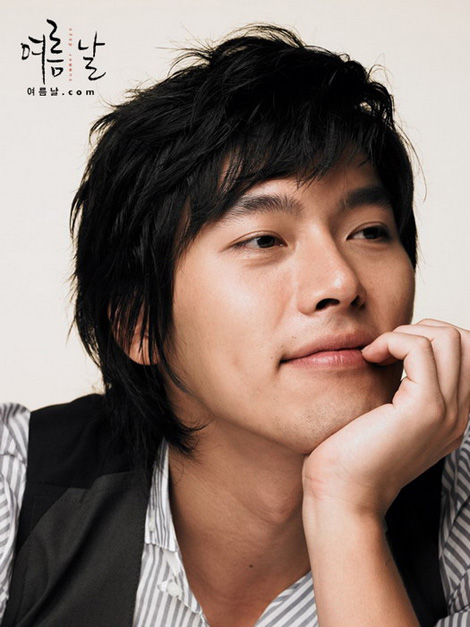
And in light of this, there's a fella named Hyun-Bin. (image)
He's been a popular Korean actor for a while, and his drama, "Secret Garden" is having its series finale right about now. Not only is he famous for his acting, the song he recorded for "Secret Garden"'s soundtrack is currently number one: this is about the Korean equivalent of being Whitney Houston in 1992, with the number one song and the number one movie at the same time. He's the buzz buzzy buzzmaster all around the Korean internets and he's twittertastic as well.
Here's "That Man" - his #1 song right now, from his #1 TV show OST.
The time has come for him to serve in the military, and rather than go for some patsy desk job, or work in military propaganda videos like a lot of stars do, he's applying to join the marines: one of the grittiest, dirtiest, frontlineiest, right-up-in-the-shit jobs the Korean military has to offer. (Article: English Chosun)
The Marines is known to be dangerous, and Korea is known to love celebrities who seem unpretentious - ones who give to charity anonymously, who choose not to use their fame to get into famous universities, who make TV appearances without makeup, and act the fool at a noraebang for cameras, so that people know they're just ordinary folks too. That Hyun-bin wants to eschew the privileges his fame could earn him, and serve the military the best he can, is admirable. (Korea Herald reports: since the North Korean shelling of Yongpyeong Island, men signing up for the marines has taking a huge jump. Attaboys!)
And readers, I guarantee you: when he does finish his service, he will have a couple of years where he can do no wrong, for approaching his military service this way, and if he plays it right, he might stretch the cachet he's earned here even longer. If you think people love him now, just wait a couple of years until he gets out.
Good for him. That's all. Good for him. And good luck serving your country, sir.