Thursday, May 28, 2026

Eulogy for my Uncle Tony; Uncle Tony for President

[Part I: In which Rob uses humor to remember his Uncle Tony (plural)]

My Uncle Tony passed away in April.

For many readers of this blog, that doesn’t mean a whole lot, but it means a really big something to me. Enough that it’s been hard to sit still, buckle down and focus on anything, or add anything to some of my bigger, ongoing writing projects, before I’ve said a thing or two about him.

I had two Uncle Tonys (Uncles Tony?)… on the same side, no less, because when my dad’s family immigrated to Canada, they took English versions of their Dutch names, and both their names anglicized to Tony. To keep things clear, the older Tony was originally Teunis, named after my grandfather, so we might call him Tony Jr.. The other Tony was the younger sibling of the two Tonys, named Anton, which anglicizes into Tony as well. As the younger of the pair, for clarity, I’ll call HIM Tony Jr.. Clear? Clear. 

If you know my dad, or me (the apple doesn’t fall far), and the kinds of jokes he (and I) enjoy, you won’t be surprised to learn my Uncles Tony Jr. (Uncle Tonies Jr.? Uncle Tony Jrs?) got a lot of mileage out of the humor in the same-name situation, partly by hanging out with a third guy, also named Tony. (Introductions got repetitive.) Both Uncle Tonys (Tonies?) have now passed on, and if heaven is the way the cartoonists and joke-writers imagine it, they’re probably hanging out by the pearly gates now, looking for other Tonies to hang out with, and making as many dad jokes as they can get away with before St. Peter downgrades their Heaven Passes.

It makes perfect sense to start a eulogy for my Uncle Tony (the recently deceased) with a bit of humor, as my every memory of him involves his wry smile, a twinkle of merriment in his eye, and a sly sense of the silly or absurd that always kept time with him interesting. Uncle Tony was a theater stage manager, and anyone who has worked in the theater knows what stage managers are like: they are the coolest, most mellow, problem-solvingest, level-headedest people in the world, and the final ballast keeping most theaters on an even keel as all the other theater people (chaos-muppets, every last one of them) dance fractal trails of destruction, glitter, tears and flower petals everywhere they go.

With the passing of the final Tony, my dad has now outlived all his brothers: my Uncle NotTony (on my dad’s side) also left this earth (and his lovely family) about a decade ago, predeceased, too, by the oldest brother Tony Jr., back in the ‘00s. His oldest sibling, my amazing Aunt Margaret (love you, Auntie Margaret!) is still around, every time I try to imagine growing up around three brothers, spending my entire life talking, joking, checking in, and sounding out ideas, hopes and plans with them, and then aging into being the last remaining brother, my brain kind of glitches out.

[Part II: In which Rob makes his uncle’s sad passing about himself…]

Among other things, middle age has really impressed on me the irrevocability of some of the choices I made back in my twenties. A conversation I had with one of my siblings and their spouse a while back really brought it home to me what I’d missed out on by choosing to live in Korea, where the time zones (and my poor track record of initiating/returning contact) mean I am just not in the loop with my relatives’ lives, their preferences, what kinds of conversations, jokes or gestures of affection do and don’t land with each of them. I haven’t sent nearly enough music recommendations or made nearly enough dumb jokes to my siblings’ kids, and the whole lot of us, and various combinations of us, haven’t eaten nearly enough meals together.  Where at some point, I think I had a really good read on all the faraway relatives I love, I don’t think I necessarily do anymore. And that is a choice I made. And twenty-plus years have gone by. It is far too late to retrace or take a mulligan on that choice. I could move back to Canada, or start making weekly calls, or arrange monthly family video chats, but whatever developed out of that would be something new, not a continuation of something old. And that is a choice I made.

I used to justify living in Korea partly by saying that even if I DID still live in Canada… my cousins and siblings don’t all live close by anyway, and I wouldn’t be driving across the rockies every year, or flying out to Ontario every year to touch base with the extended family anyway, so what difference does it make whether I’m not seeing them from Vancouver or not seeing them from Seoul?  …but then, when a Big Life Event happens, and I don’t have the option of driving out, either for them or for some of my dear friends (who live spread out across Portland, Calgary, Seattle, Toronto, Hamilton) upon receipt of a certain type of phone call.

As my Uncle Tony’s funeral approached, my extended family started sharing photos and video clips of the late Uncle Tony, and stories about the last time they’d seen him. I got to see that smile, hear that laugh, and a big part of my grief was that I hadn’t made a point of seeking him out nearly as often as he deserved. Every person who shared a memory of Uncle Tony had something to say about his kindness, his welcoming and inclusive attitude, the way he made people feel seen, appreciated, and worth his while. And I wish I’d spent more time basking in that goodness myself. That is a good kind of goodness to bask in. May we all be pickled in such goodness, enough that we can’t help but share it and pass it on.

None of this is to say that my life in Korea has been barren or devoid of good people, good times, or wonderful experiences. We all make choices in life, but thinking back on the three uncles I’ve lost on my Dad’s side (and the one on my mom’s side, my grandparents, former roommates, and the list goes on…) it strikes me, again and again, that the snatches of memory I have of each uncle aren’t nearly enough. Sitting on the floor watching one uncle play guitar, walking around the cobblestones of old town Hamilton with another uncle, or one of his awesome kids, bobbing up and down on Lake Superior’s waves as the latest late uncle showed our family around the islands and coastlines of Lake Superior on his sailboat. 

[Part III: In which Rob pontificates, because that is what Rob do]

It’s amazing how different the world looks, just based on where I fix my gaze. One of the things dragging on my mental health lately is doomscrolling: the social media, youtube or news feed links and clips about a world that is becoming more chaotic, less stable, where the most powerful and wealthy humans seem to be grabbing power and wealth as fast as they can, meanwhile capturing, corrupting or rendering irrelevant every institution that I thought could help the world figure out its problems. And as I’ve paused to think back on the wonderful uncles I’ve had in my life, the contrast jumps out like a camera flash: somehow the worst humans in the world hold all the power and influence, and litter every news cycle with their latest garbage attempts to cash in, instrumentalize or exploit the decent, ordinary humans who don’t have the power or influence to push back on bullying and exploitation from the powerful. Yet my actual, lived life, my circle of friends, relatives, and acquaintances, is loaded with good, kind, interesting, fun, generous, and good-hearted people, who mean well and want to make life better for the people they know. The world is full of good people, wonderful people who deserve more of my time than I have to give them. Who deserve more of my time than I could give them if I could live each day three times. Most people are decent, good, and want to do good to or for other people, and leave behind a trace that includes memories of kindness, helpfulness, generosity, humor, patience, and all kinds of other goodness.

I’m not sure what it would take to put people like Uncle Tony in charge of the world. I know that the kind of people who raise their hand and offer to run things are usually the last people that should — “it is not that power corrupts, but that it is magnetic to the corruptible” (Frank Herbert), and when good, decent, conscientious and well-meaning people end up in charge, it is more likely due to sheer luck than their actual virtue. I do know that I wish I had more of Uncle Tony in my life, and that the world would be a better place if there were more people like Uncle Tony in it, running as many of the important parts of the world as possible.

Uncle Tony is survived by a wife and two kids who ARE echoes of the goodness, the humor, the grace and mischief that made Uncle Tony so much fun, and my life is richer for knowing them and their families as well. And they’re still around, so it might be time to start reaching out a little more, while we are still sharing this silly planet, so that neither of us feel these kinds of regrets when one or the other of us moves on.

Rest in Peace, all my Uncles. 

Be excellent to each other.


Tuesday, September 23, 2025

DadJokeapalooza

I am in the midst of gathering all the silly poetry and other writing I've written in other spots into places where I manage them. I published some articles in one of Korea's English language newspapers, and after they redesigned their website, they are nearly impossible to find, and all the links that used to work have gone dead, and I don't like that. So before websites disappear, or all our content gets Zucked, here are some poems I shared while trying to crack up a few friends on social media. You'll figure out how they work pretty quick, I think.


Roses are red
And this is nonsense...
Think you know the quotes?
Guess in the comments!

aaand:

Roses are red,
Glass cracks and won't bend
If you can't guess the answers,
They're now at the end.


Roses are red,
Lemon's tasty in pie
Why'd I give up the answers?
I'm just a nice guy!


Roses are red but sell them in vain

Roses are red, Preppers like spam

Roses is reds violets is blues

Roses are red, blue jeans are pants

Roses are red, smartphones can take pics

Roses are red, whatever your mood

Roses are red, and ivy can climb

Roses are red, violets are blue

Roses are red, pancakes are flat

Roses are red, wind-catchers dance

Roses are red, many crows make a murder

And now.. here are your answers...

Roses are red
But sell them in vain
“I have had it with these motherfucking snakes
On this motherfucking plane!”


Gone with the Wind:
Roses are red
Preppers like spam
“Frankly, my dear,
I don’t give a damn.”


Roses is reds
Violets is blues
“I’m gonna make him an offer
He can’t refuse.”


Zoolander
Roses are red
Blue jeans are pants
“What is this? 
A center for ants?”


Legend of Zelda
Roses are red
Smartphones can take pics
“It’s dangerous to go alone!
Take this.”


Roses are red
Whatever your mood
“You lewd, crude, rude
Bag of pre-chewed food dude!”


Top Gun Ending
Roses have thorns
And ivy can climb
“But you can be
My wingman any time!”


Pulp Fiction
Roses are red
Violets are blue
“I’m gonna execute 
every last fucking one of you!”


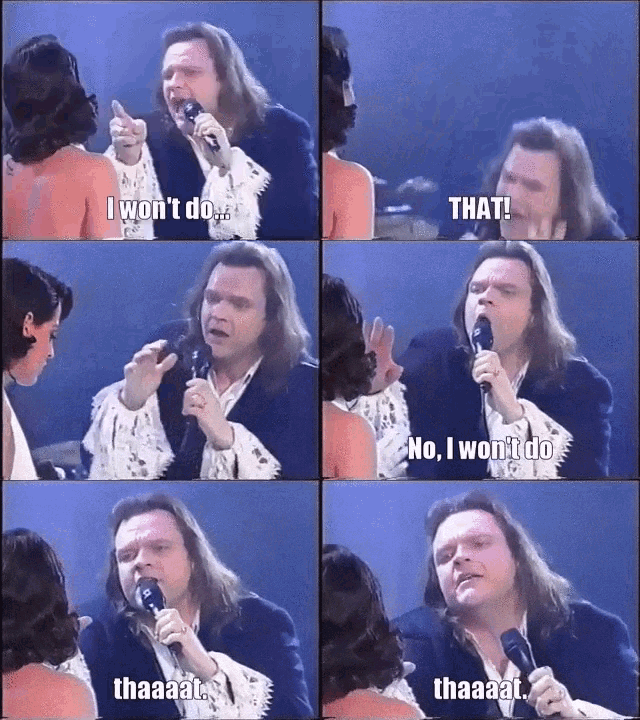
Meat Loaf
Roses are red
Pancakes are flat
“I would do anything for love
But I won’t do that.”


Dumb and Dumber
Roses are red
Wind-catchers dance
“So you’re telling me
There’s a chance!”


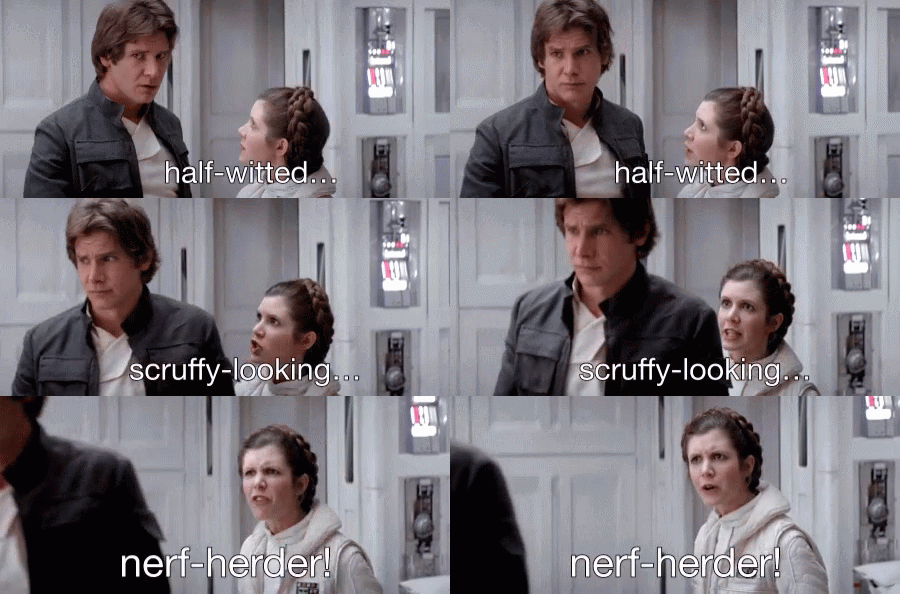
Empire Strikes Back: Han and Leia
Roses are red
Many crows make a murder
“Why, you stuck-up, half-witted
Scruffy-looking nerf-herder!”

Saturday, May 17, 2025

Responsibility #ForAllMen: Stop Being The Bear!

Ooh... fuzzy!

[We join mid-conversation, as I, Roboseyo, discuss the implications of the Bear In The Woods meme with Rocco, the Fictional Person Who Argues With Me.]

For context, read part one of my Bear In The Woods Manifesto


Rocco: “Okay. I get it. [See explanation in previous blog post] But I’d just like to point out that any persuadable person would have already been persuaded 400 words ago, Rob.”

So you admit you don’t want to be persuaded?

Rocco: “I admit no such thing. I just want to know why you are really still going on about this?”

I’m glad you asked.

Rocco: “Oh, no. That’s your ‘pontification’ face.”

It is.

Rocco: “What have I done?”

Let's travel back in time a bit, to see the bigger picture:

When #MeToo went super-viral in 2017, part of the conversation went underplayed. We got distracted by gleefully watching a few horrible men like Bill Cosby and Harvey Weinstein finally get their long-delayed desserts (both walk free at the time of writing, but that’s a different rant). However, one thread of the conversation kind of fell to the wayside: the threads discussing what part ordinary, non-rapist, well-meaning men could play.

The lone facebook post I saw on the topic, by some social media user now lost in the sands of time, had some choice words:

“Now that it has been successfully impressed upon us how common and far-reaching harassment and assault are, the next step is to reflect on the ways our society has … failed to notice or correct the attitudes and actions that led to [#metoo].

But real talk: using "as a society" and collective language is dangerous too. It is yet another way of absconding personal responsibility, of distancing myself from what is happening. No mincing words: I individually have participated in excusing, ignoring, tolerating, enabling, and otherwise failing to notice or correct attitudes and actions of sexual harassment and assault.

I want you to know that I don't just believe you, I'm acknowledging that I've exhibited some pretty unsavory behavior in my past. I've been looking at this for a long time now, and I've definitely been the guy who…

Here the poster lists some ways that he’s added to the environment where so much bad stuff is ignored, brushed off, or tolerated, that worse stuff happens too, and he finishes with this line, which I want to pull out of 2017 and bring it back to 2024.

“It does us no good if all the men think that every "me too" was somebody else's fault.”

Sometimes I teach the “self serving bias,” in class. It's the bias we use to re-interpret a situation, make ourselves an exception, and somehow let ourselves off the hook. #NotAllMen is an example of this "exceptional" thinking. "I'm one of the good ones, so #MeToo doesn't concern me!"

But one more time with emphasis: “It does us no good if all the men think that every "me too" was somebody else's fault.” ...and what are the protestations against the bear in the woods thought experiment, except men continuing to point fingers, and say that #MeToo was #NotMeThough, and seeing that it was #DefinitelySomeoneElse, #WhatDoYouThinkICanDoAboutItAnyway? Well, lots.

Rocco: #NotAllMen, amirite?

Me: (buries face in both hands for a bit)

This challenging sentiment didn't gain much traction, because given a choice between pointing a floodlight at our own bad behavior in order to have some uncomfortable, probing, high-stakes conversations with an indeterminate number of the women around us, and pointing fingers at a few obvious villains getting their just desserts, we predictably went the easy way, and schadenfreuded it up over Weinstein and Cosby having to do perp-walks. Add R. Kelly and Diddy to that list.


Don't get me wrong, it was satisfying, and pointing fingers at monsters can be fun, but focusing on the atom-bomb-level awfulness of "America's Dad" serving women spiked drinks and an Oscar-winning bully in a bathrobe forcing himself on starlets drew attention away from a much harder, more nuanced topic.

And now, years later, The Bear Discourse is as good an opportunity as any to circle back to big ideas from 2017, and talk about the way even well-meaning men who Hold the Right Opinions can still contribute to the background radiation of sexist pain-in-the-assery that makes women feel a tiny bit unsafe most of the time. Sure, there’s no-brainer bad stuff going on: there'll always be somewhere to point fingers if I really want to wiggle out of my own culpability or pose on a moral high ground, but beyond the "call the cops or alert HR" stuff, there’s a lot of “death by a thousand paper cuts” stuff to discuss. Conversations about racism led to inventing the term “micro-aggressions” for these.

You know what I'm talking about. Mechanic shops assuming a woman knows nothing about cars. Asking only the female coworkers if they’ve thought about marrying or starting a family. Paying extra attention to the most attractive woman in a group, while ignoring older or unattractive women. That kind of stuff can be corrected with a little work. There’s even smaller stuff  (call them "nano-aggressions"?) that could be a micro-aggression, but might not even be noticed — either by the woman it targeted, or by the man who might have done it unconsciously. Stuff like giving women the up-and-down with the eyes as she walks by. Not catcalling, not whistling... but still eyeballing. Stuff that the culture just does, that we take for granted, might fit here -- like movie trailers and ads putting women's bodies on display. Movies pairing up a man over fifty with a woman under thirty. Maybe a particular woman doesn't consciously notice it all, but if she does, such tiny things all send the same message: “being a woman is the most important thing about you,” “being young and attractive is more important than any other thing about being a woman,” and, ultimately, “This is a man’s world.”

But that still doesn’t cover it, because it’s not even just the tiny things we do, the micro-aggressions. There are also what I’m calling micro-elisions -- the tiny things we don't do -- that make women unsure if a guy, even that guy who loudly announces he's a feminist and wears the t-shirt and writes multi-part blog posts, would believe her if she told him something.

Here’s a little text image meme that made the rounds a while ago that encapsulates the idea of micro-elisions better than pages of explanation, in a simple story: 


I'm just gonna write that out for anyone who's using a voice reader, or some other visual assistance for reading. Skip if you already read it.
 
"When my daughter was 15 we went for lunch at an upscale steakhouse. As she was walking to the ladies room a table full of men were staring at her. I saw, but could not hear, one of the men say something to her. She clenched her fists, her shoulders stiffened, and she speed walked away from them. 6 men at the table. One of them made a sexually suggestive comment to a child. Not one of them called him out on it.  
 
I got up from our table and went up to them. I looked the creep right in the eyes and told him that I didn't know what he said but I knew it made my child uncomfortable. I then told them all that when she walked back from the table if even one of them made eye contact with her, let alone said a single word to her, I would create a scene that they'd never forget.

Five men watched another man sexually harass a teenager and said not one f**king word. What the man said to my kid? "Are you my dessert? I'd eat you in a second."

She wasn't protected by the men who stayed silent. 

She was protected by me.

It. Is. All. Men. Period.

Six men at the table, meaning five men who heard Chad’s lewd comment could have said, “That was disgusting, bro. Don’t ever talk to women like that around me again. Especially minors.” Five men, who probably all think of themselves as good men, said nothing. “Well, it wasn’t ME making the comment.” If one of them had spoken up, Chad might think twice before being so disrespectful again. And next time, a second guy might agree that Chad was out of line. Called out by TWO buddies? That would change the color of that entire social group. Doing nothing IS a moral choice when something wrong is happening, and that’s why we need to talk about micro-elisions. Most of our lives don’t have moments where the time to take a moral stand is obvious, cut-and-dried, clear and signposted. If you wait for your August Landmesser moment, life will pass you by, and who knows how you'll feel looking back on those times you calculated it was better to go along to get along.

And that doesn’t just go for saluting genocidal madmen. Being at that rally, ready to salute a genocidal madman is one knot in a long long tangle of choices the other people in that photo made, in order to be where they are, willing to do what they did. That tangled string started long before the rally, and stretched from the day they took that photo in 1936, to all the horrors that followed. 

People don’t wake up in the morning and think, “I’d like to take part in a genocide today.” People make little decisions, over and over, and tell themselves they haven’t reached the point of no return yet, that they can turn back if they want. Maybe deciding that each decision was really "51-49%," or thinking, "I should speak up, but the timing is wrong," pacifies their conscience. Like smoking. Like frogs in a kettle. That’s the danger of micro-elisions, of choosing to be a bystander: those choices add up.

Micro-elisions aren’t the crime itself, but because of them, the crime becomes that much more possible. Less

still my favorite picture of sharks.
from memebase/cheezburger.com

unthinkable. It's like shark attacks. Shark attacks happen. They happen under certain conditions, but all those other conditions depend on this: there needs to be salt-water, because sharks can’t survive in fresh water. Imagine these micro-aggressions and micro-elisions are the salt that turns fresh water into salt water. After you've got salt water instead of fresh, those other conditions for shark attacks start to appear, and sometimes stack up, and from there it’s scary game of odds. That is the effect micro-aggressions and micro-elisions have. They aren’t the crimes, they don’t directly cause the crimes, they're so pervasive it's hard to measure them, and on its own, each one is far too insignificant to report, but added up together, well, now we’re swimming in water where shark attacks are possible, instead of water where they’re impossible. It’s the same color, but the water is no longer safe to drink. A little whisper says, "I bet you could get away with it." The unthinkable becomes thinkable. 

This is basically a fish-intensive way of explaining another phrase that always gets people’s backs up… the way fresh water becomes the type of water that can sustain the creatures responsible for shark attacks? That’s what people are trying to describe when they talk about “rape culture.” The R word is pretty shocking. This is the point for some people who use it. And the shock-value of the R word leads to a lot of defensive responses, but when someone starts talking about rape culture, fellas... try to cool it, and just think about Shark Week, ok? Please trust me on this, my put-upon-feeling brothers: the goal of using that word is to startle you out of complacency, not to accuse you, personally, of being a rapist or a would-be rapist. Promise. People who use that phrase want to talk about the process that takes something unthinkable, and makes it thinkable, that’s all.

I’m not a rapist. Far from it, but the whole point of having this conversation is to reckon with the fact all of us (even women) are tossing salt in the water, contributing to that atmosphere that makes the unthinkable thinkable. 

So… rape attempts? Nah. I’m not responsible for that one in six. But I’ve done my share of micro-aggressions - staring when I thought she didn't notice (maybe she didn't notice, but maybe she did), trying to make eye contact with someone who clearly wanted to be left alone, trying to turn a conversation into a flirtation, or a flirtation into whatever comes after a flirtation… that time at the club when we were dancing and I accidentally brushed a body part, and she might not have even noticed, or she might have taken it as flirting, so I tried to accidentally brush that body part again. Micro-aggressions, and some stuff that was bigger than micro, too, if you come right down to it.

I’ve certainly done my share of micro-elisions, too. I should have said, “That’s disrespectful, dude,” but instead I laughed at the joke. Didn’t want to be a stick in the mud. But my laugh might have sent a message to someone else who was also uncomfortable, “don’t be a stick in the mud; nobody else minds.” That micro-elision turned us both into bystanders. The time the couple was arguing, and the boyfriend — taller and much heavier — started looming. You know the way big boys sometimes loom, put their hand on their girlfriend’s neck with that faux-tenderness that is part threat. I moved down the subway platform, instead of staying close enough that the girlfriend knew there were witnesses nearby. “Don’t get involved.” Micro-elision. 

For my micro-aggressions and regular aggressions, for my micro-elisions and regular elisions, I have my excuses lined up: “I was young, I was in a bad place at the time, I thought I was being funny, we were both drunk, or tired, or both. We started out just being playful! I thought she was into it!” The excuses come to mind effortlessly, even years later. I’ve pushed a few lines when I knew better, or said nothing as someone around me pushed lines. I’ve gotten into situations I shouldn’t have, or stood by while someone engineered an unsafe situation, and instead of getting someone out of an unsafe situation, I lined up my excuses, putting my own conscience above someone’s safety. By ignoring, or never teaching myself to notice certain things, I could maintain my self-image as a good guy, while still getting away with some stuff, never suffering the discomfort or paying the social cost of being the stick in the mud. Did anyone else notice my action, or inaction? I'm not sure. Would anyone blame me? Probably not. There were other bystanders, too. Were there other incidents where I didn't even notice what I'd done, or what was going on? I'm absolutely sure of that. There were times I went far enough that I have made some apologies to some people. I've played my part.

It was easy to focus on the Weinsteins and the Cosbys. But that much subtler, much harder and more inward-looking work has to happen too if we want a real cultural change. Stuff like the bear meme will keep going around until one of them brings home the fact everyone plays a part, however small, and even well-meaning good guys who showed up at the rally can probably find ways to become better.

And it’d be a better world if part of some men doing better was by challenging other men to become better, too. Because if all we get is pick-me posturing, without self-reflection and accountability from man to man, the fact “one of the good ones” is doing less than he could is the other thing that makes women feel like no man is entirely safe, and the bear is a better pick.

“If the bear attacked me, people would believe me.” That women feel they won’t be believed shows that ALL of us have failed, not just the predators. 

When #MeToo first broke, a friend suggested I write something like what I just wrote above — about the part men need to play now that women have pulled the worst moments of their lives out and set them on display in order to plead with us to finally, at long last, believe them. It’s sad, and kind of gross, the scale of display that it took to get some men to snap out of denial and gaslighting, even for a short time. My friend suggested I talk about the little stuff, and the stuff even #GoodGuys do when they think no one’s looking, stuff I did, which she knew about, as a call for everyone to do better, not just to externalize the finger-pointing and claim an easy moral high-ground over the Cosbys of the world.

My friend suggested the hashtag, “#ItWasMe” – I was part of the background radiation that sets women slightly on edge about their safety at all times. And a few times, I was more than just the background radiation. To my shame, I didn’t have the courage to stand up with such a challenging position at the time, because I was worried about confessing some of my own actions and failures, those things I apologized for in the past, those apologies I made to others, and promises I made to myself.

When I look back on my life? 

I’ve held and expressed opinions that didn’t respect women. I might still be wrong about some stuff.

I’ve participated in a broad spectrum of shaming. I’ve held and passed on stereotypes and sexist judgments about a few women I’ve known. I’ve worked on this a lot.

Around other men, I’ve definitely laughed at that joke, or said nothing when I should have called out a gross word or attitude.

For all I know, one of those times, I sent somebody the message that it was okay, or cool, or acceptable even for people like me to hold such views or laugh at such jokes. That guy had lots of his own choices to make on his own personal path toward misogyny, and he’s responsible for himself in the end, but on his path, I could have been a roadblock, and instead, I stepped aside. For all I know, my choice to go along nudged someone else into becoming a bystander, too. Even trying to be mindful, I probably still miss some opportunities to be better. Maybe lots.

Back in my single days especially, I know I’ve pushed lines where I knew better, and I’ve been pushed away, had a line drawn, and tried again anyway. That's stuff I am ashamed of now, and sometimes stuff I was ashamed of then, too, but in the moment, I had my excuses lined up. I made some hard apologies to some people after a few such incidents. Twenty-plus years later, it’s hard even now to write this and hit “publish.” The temptation to make this paragraph even more vague than it already is, or delete it, or publish it as is, or add more details, is creating a little whirlpool of back-and-forth in my mind.

But without flinching, every man needs to reckon with their part in that background radiation making things crappy for women, with those times they pushed a line, or let it slide when a guy friend talked about pushing a line. The times they lined up excuses, and the things they did while hiding behind them. Men can’t fix sexism on their own, but there’s a lot of stuff men can do, and there’s stuff men are best positioned to do — like talking to other men. Maybe not even to change their mind, but just to plant a seed. Men can be there in the locker room to shut down “locker room talk” that creates the permission structure for further disrespect. Or maybe not shut it down, but take most of the fun out of it. The more of us do it, the easier it is for each of us. Many hands make light work.

To be less passive about that, men need to look in the mirror… be honest about why she chose the bear, and go about changing the conditions — one locker room and restaurant table at a time — that keep creating men who are scarier to women than a wild animal. The first step, men taking a look inside, accounting for their own thoughts, words, and behavior, and being honest about their own worst points and weakest moments, is pretty damn hard, but without it, all the other steps are just posturing.

Saturday, May 03, 2025

My World Famous Friend's Podcast

For anyone who doesn't know (because I've told them), my closest brushes with fame are:

  • I once cooked spaghetti for a Christian rock band
  • My uncle loaned Avril Lavigne the guitar that she used to learn how to play, back when she was an ambitious little whelp in his church praise group.
  • I once passed model/movie star Jeon Jihyun at a bakery, close enough to make accidental eye contact with her
  • I shook the hand and snagged a selfie with a sitting president of Korea (who later spent time in jail)
  • During school, my wife was in a club with a guy who is now a major Korean film star. He came over to our house after Babyseyo was born
  • I randomly bumped into a one of Korea's greatest classical violinists at a cafe once, and she and my wife now regularly exchange holiday gifts and stuff
  • I was on a TV show where I judged the cooking of Yu Jaeseok, the guy dancing in the canary yellow suit in parking garage section of the Gangnam Style music video (who has also been Korea's most loved celebrity for a very long time)
  • Korean-American popstar Eric Kim once guest-hosted a radio show I was on
  • My best male friend during university is now an acclaimed, world famous New York Times Bestselling Author (that's what the book jacket says, and I'm going with it)
Well, ever since I knew him, before podcasts were even invented, Mr. Jonathan Auxier has basically been born to run a podcast. He has a nice speaking voice, takes pride in having thoughtful views and expressing them articulately and clearly, looooves hashing out ideas, is very good at disagreeing with people nicely, doesn't take himself too seriously, and talks about the world in a way that is a pleasure to listen to, using idioms and vocabulary in interesting ways, always trying to get the ideas in his head to come out of his mouth precisely right.

Mr. Auxier is now hosting a podcast called "A Good Story Well Told" (and if I'm not mistaken, that looks like his artwork in the logo). In it, he and another world-famous super-successful acclaimed author discuss books and other stories, their strong and weak points, and what would-be writers can learn about storytelling from their examples. If you love stories, or if you're intrigued by what makes one story work, and another story fail, that's exactly what they talk about, and you'll enjoy it a lot.

For me, I love looking at stories, disassembling them into their component parts, and figuring out why they did or didn't send me on their intended journey. When we were in university together, along with other topics, he and I stayed up all hours of the night talking about the movie we'd seen or the story we were reading for a class, doing exactly what he's now doing with another friend in this podcast.

So, if you love stories, listen to the pod. If you are one of my friends and you used to hang out with Jon, these will take you right back, and if you just like hearing two guys talk about something they know a lot about, this podcast is one of those. For me, it really was like sitting with my old friend for an hour, and I'm grateful for that. I miss him sometimes.

Go forth and enjoy!!

Friday, December 27, 2024

Squid Game Season 2 Predictions: Before I Watch

 Okay. Here are a few thoughts before I start watching Squid Game Season 2:

First, on the scale from "Sequels that made the orignal better" to "Sequels that were either unnecessary, or disappointing" (from T2 to Matrix: Revolutions) I give it... 75-25 odds that it will be a Matrix 2, not a Terminator 2.

Because I'm Rob, and this is my dang blog, we've got to overthink things, naturally, so here are some recipes for a good sequel. For simplicity (HAH!) we're skipping reboots, spinoffs, second chapters that had always been part of the plan, and prequels here, with apologies to Fury Road, Lightyear, Dune Two: Dunin' Time and Exorcist: When Pazuzu met Father Merrin.

1. The T2 template.
We saw a little of a world, but the film didn't explain everything, and at the end of the first movie, we still had Questions, or there were themes rich enough to warrant Further Investigation.

The T2 template takes the first film, and creates a sequel that fleshes things out. It answers some questions, and might look at the same/similar issues from a slightly different angle. There will be some new stuff -- characters, ideas, or wrinkles, and it might even introduce new themes, but everything is still of a piece with the original. At its best, it makes a world feel bigger, and more lived-in. The conflict or the Thing the Protagonist Wants might have grown in scale, complexity or nuance, and we understand more about how things work in that world, what tools the hero has to solve the problem, and what kind of person the hero is, or what kind of world they live in.

Successful examples: Terminator 2 and Empire Strikes Back are the high points of this template. John Wick 2 fits here, and the first two How To Train Your Dragon sequels.

Less successful attempts at this template: The Matrix 2 -- you forget how much exposition Matrix 1 had, because the pacing was so good, and the concept was so fresh, but The Matrix 2 was really, really talky, too much even for peak Monica Bellucci overcome (noble attempt, though). Were Avatar: The Way Of Water and Terminator 3 different enough from the first one that we really feel like we learned more about the world, or the main characters? Did they expand on the themes of the original enough to feel satisfying and unique, or introduce new themes that fit the original, but took them somewhere new? Or was Avatar 2: The Way Of Water basically just Avatar, But Underwater, and Terminator 3 simply T2 Again, Except Now the Killer Robot Is A Smokin' Babe?

2. The Godfather 2 template.
Take a world that gave us a character we liked, and put that character into a new or different situation that reveals something new about the character, and/or about the world, and/or deepens the ideas or themes or characterizations. It might even question or complicate the initial premise of the series, forcing us to reexamine its themes, or add a "but at what cost?" to the hero getting what they want in the first movie.

Successful examples: Godfather 2 is very much the same world as 1, but Michael Corleone is in a very different situation now, and the film takes the themes that made made the original resonate: family, loyalty, ambition and power, and really puts them to the test through the big betrayal. Indiana Jones and the Last Crusade took that same great Indiana Jones character... and gave him an impossible-to-please father. Suddenly the confident swashbuckling hero is just another kid trying to win his father's approval, at the same time as dad is trying to keep up with his son on the swashbuckling side. It's a different look at a great character... but still the same package: it's very much an Indiana Jones film in pacing, storytelling and tone, but Indy is more relatable than ever before. Spider-Man 2 (Tobey Maguire, 2004) had Spider-Man asking if it was worth being Spider-man when it put his loved ones in danger and complicated his life. Meanwhile we saw more heroes, more aspects of Peter's life, and more complexity in the relationships established in Spider-man 2002.

Iron Man 3 gave an interesting version of this when it gave us Tony Stark dealing with PTSD after saving the world -- we'd been accepting the idea of superheroes stepping up to save the world for a long time by then without anyone asking, "Would a person who became a superhero... be okay?" Captain America: Winter Soldier asked, "What if the ultimate loyal soldier lost the certainty that his commanders were the good guys?"

3. The Aliens template
Take a world we've seen, where we know the basics of how it works, and offer us more of everything. This is similar to the T2 template, but taken further. More characters, more settings, more action, more things the protagonist or antagonist can do. New powers, new spells, new places. On rare occasions, this type of sequel can even be a whole different genre: Alien is a slasher/horror film, and Aliens is a military propaganda shoot-em-up '80s action movie.

A lot of superhero and fantasy sequels do this one, with varying levels of success. Iron Man invents a  suit that does more stuff. The Chosen One character studies under a mentor and masters the five point exploding palm technique, or travels to a new country to find The Really Important Thing. Thor unlocks new powers and goes to a whole new planet. 

1 and 3 are both on the "take the original premise further" spectrum, and this is the tightrope many sequels must walk: take the original premise too much further, and it might not even be recognizable as part of the same world (Gremlins 2: The New Batch is absolutely bonkers, to the point that it approaches the sublime, and makes criticism irrelevant); don't take it far enough, and the sequel is just a rehash, stale leftovers that add nothing. (Taken 2-11, Austin Powers 3: The Spy Who Repeats Gags, all the Home Alone sequels, and Jurassic Something Or Other: How Many Of These Are There Now?)

4. The Mission: Die Harder Faster and More Furious Forever Template
Just keep cranking out copies of the original. Make the chases more expensive, make the explosions bigger, make the technobabble more bewildering, stack more hot celebrities into the cast like cordwood and put the characters into new settings, and a certain kind of audience will come back for second servings like an all you can eat sundae bar.

This is fine. It's fine. Nobody got mad at James Bond for offering... basically the same movie... twenty times in a row, resetting the premise like a sitcom episode, before Daniel Craig's Bond first demonstrated that he remembered what happened the film before. Tom Cruise's commitment to practical effects and his insanity in doing his own stunts in the Mission Impossible movies will continue to be compelling until his body gives out or he dies on set, which I think is ultimately his life goal. Just keep mixing the elements together in new ways, like shaking a snow globe, and give us more John Wick suits and pistols, more Halloween rubber masks and meat cleavers, more superhero wisecracks and brain-addled slurring pirates, and more sneaky velocirapors and xenomorphs in your Jurassic and Alien franchises. Our appetite turns out to be bottomless.
 
Offering the same themes, feelings, and characters again and again can still work,  even on critical and artistic terms. Somehow the Toy Story series keeps adding installments, and each time we think, "It's already perfect. No need for another!" but then the new one feels as essential as if it had always been part of the plan. They're not changing the industry with new ideas, but the Paddington movies are just as charming on the twentieth rewatch as the first. It's magic, what they do.

It's like a late night booty call: you know why I called, and I know why you answered the phone.  It's not exactly romantic to show up at a FWB's door half-drunk at 1:30am, but that was baked into the bargain from the start too. Nobody overpromised, and everybody got what they wanted. It's fine.


5. The Rambo II Template
Grab a few working parts from the original, patch them together, and run with it. Some filmmakers even tell their creative team NOT to read/watch/learn about the source material. Sometimes this works: Army Of Darkness turned a low-budget horror film and its high camp remake into a sublime supernatural time-travel horror-comedy. Rambo II had little connecting tissue with First Blood other than muscles and guns but it put bums in seats. Sometimes it doesn't work. Cars was a sports movie, Cars 2 was a spy movie, and other than the occasional "Kachow" and, you know, talking cars, they were so different I had whiplash. If you went into Gremlins: The New Batch expecting anything like what you got from the first Gremlins film, you didn't know what the hell you were watching. (You were watching a work of pure cinematic genius, that's what. The ultimate logical conclusion of the slogan, 'Every idea is a good idea.')

So... before I start watching episodes of Season 2 of Squid Game (and yes, I know that a new season of a TV show might work differently than a sequel to a movie... but the limited play time, and the long period between original and follow-up make me feel more like I'm watching extended movies or mini-series' than straight-up TV shows), I'm going to predict a few things, and then see if I'm right.

First, I think Squid Game is in a difficult spot. The hardest sequel to make is for something that everybody loved because it was so fresh, so unique, so unlike anything we'd seen before. We'd seen "games to the death" shows and "making sport of human lives" shows before (Hunger Games, Battle Royale, The Hunt, The Running Man, Escape Room, many inspired by a famous short story titled, "The Most Dangerous Game" --these films have been coming out since the 1930s), but the cognitive dissonance of using children's games, bright colors, grade-school musical instruments, and preschool production design created a mood that nobody had seen before, a mood where the contrast between the silliness of the games and the dread of the consequences grabbed the audience and added all kinds of layers about how the elites are treating the desperate class. It arrived in the middle of the first pandemic year, when everyone was sitting at home, inequalities had just been given a big old boost, and a lot of people were feeling fed up with... just .... things in general, as well as feeling jerked around by elites who didn't understand or care about them. It was the perfect set of themes, packaged in the perfect way, at the perfect time, to an audience perfectly prepared for it. It really was lightning in a bottle.

But how do you offer season two of something everybody loved because it was unlike anything they'd seen before?

It's not unlike anything they've seen anymore: at the very least it's like, you know, season one. And that's the problem. You can't be unlike anything we've seen before twice.

You can't make a Squid Game season that will cause the sensation that Season 1 caused. We're not shut in on lockdown anymore. We're still jerked around by the elites, but we have different outlets for that feeling now, whether that's the rantings of this or that politician, or this or that angry podcaster, or constant refreshing for updates on that story about that guy who shot that other guy. We've seen the primary colors and the kindergarten shapes and the childish games with deadly consequences all before. We've rooted for characters only to see them die in gut-punch twists. Nothing will ever land like the gut-punch of episode 6, the marbles episode, in season one, because we already saw that one, so now we know the showrunners are willing to do... that to the characters we care about. You can't kill Ned Stark twice. After the first time, you already know that anyone might be next, and that cat doesn't go back in the bag.

All that to say... for everyone expecting something as fresh and novel as Squid Game season one was... this season has its work cut out for it.

So which template should Season 2 follow?
The T2 template: add more, fill in more background, add new characters maybe, and expand on existing themes.

Well, I'd say that the final episode of Season 1 already filled in what background we needed. The conversation with the guy who invented the Squid Games basically made the statement the showrunners wanted to make about human nature. I don't see that adding backstory or depth would really add much to the characters here, and the only way to deepen the philosophical underpinnings would be... a ton of long, boring conversations. The characters in competition already had nuance and depth, and most of them died. The characters who weren't in competition -- The Salesman, and Front Man, and the guards and the VIPs -- work better if they are cardboard cutouts, I think: defining the parameters where the deadly games occur, and the basic inequality on which the games are premised. The cop who was undercover already revealed who he is, and dedicating an episode to his backstory isn't going to add much to the role he is playing in the story. The VIPs work better if they're cartoon caricature villains, mustache twirling bad guys with brazen vices and idiotic tendencies. I don't care which of them has a backstory that makes me pity his emotional vapidity... it doesn't strengthen the story for me to know that.

Can they expand the story into new settings and situations? Not really -- at least, not without Squid Game starting to look like other shows and films. Send them into nature and you've got Battle Royale. Send them into a booby-trapped nature or urban setting and you've got The Hunger Games. Send them into the city again (which they already did in Season 1, when everybody came back) and you run the risk of reminding viewers that... the desperation the characters felt in real life is the desperation we all feel already, and ... then Squid Game is a bummer, and yet another "life is hard" drama, instead of a fresh new view of that frustration and exploitation. I don't think Netflix is in the business of inciting revolutions.

It's really hard to think of ways for them to do something new within the premise, other than the totally, TOTALLY expected move of having the inmates revolt and try to blow up the games... just like they did in Hunger Games 2. Just like almost every hero in a "Humans hunting humans" story turn the tables on their hunters in the end. Oh. I guess not then. How else can you expand the premise?

I guess we'll see.

The Godfather 2 Template
Is there a place where there's room to subvert some of the characters or themes of season one? Not a whole lot, because most of the interesting characters died -- including the most interesting one, constestant #1, the old man. I'm not wild about the idea of dedicating part of a season to the motivations of a character who's gone. Maybe Front Man and his cop brother would have something interesting to add... maybe... but the themes of frustration, desperation and inequality? How do you poke at those or subvert them? The only way is by pointing out that we are watching these characters suffer just like the VIPs are... so why are we feeling empathy, or identifying with the contestants, comfortable in our living rooms with netflix on? ...there is some room for that, if the show finds a way to get that meta without being heavy handed, and even with very strong themes, Season 1 never struck me as being preachy, moralistic or heavy handed as it was.

Who would have second thoughts, anyway? One of the guards? How would that play out? The idea of seeing the games undermined... that could create some strong rooting interests. The theme of fair play -- "at least in these games, everybody has an actual shot" did run through last season, and breaking that trust might be interesting -- in Season 1, the doctor who was cheating suffered the consequences, reinforcing the feeling that fair play mattered. Also, that feeling of "That's not fair!" "He was cheated!" outrage... we HAVE already felt that in episode 1, at least once, and maybe more.


Other than that, which of the themes would bear being subverted? Your desperation isn't really that desparate? This inequality isn't really that exploitative? Nah. Those aren't working for me. Wouldn't go over well. Packaging similar themes in new, poignant ways is probably the best way for this season to run, and that will come down to bringing us a new set of characters we care about as much as we cared about the contestants in season 1, a tall order.

The Aliens template
This could be interesting -- offering more Squid Games, in bigger, broader and more impressive ways, and a lot of it could be achieved simply with which games they choose to play this time around, what contestants are asked to do. Maybe the compound where the contestants are kept can be shown, explained, and expanded. Maybe we can learn more about the guards... though that would take a lot of doing, a guard revolt could reveal interesting things about how the games work, except that it's pretty clear stepping out of line equals a bullet in the head for guards. A police raid? That would puncture the sense that this whole thing is enabled by collusion of the powerful. That wouldn't fit the themes at all. An escape attempt? Now we're getting warmer. That is my best bet for ways to expand and explain the Squid Games world while keeping its premise and main themes intact. Another would be further adventures of Hwang Jun-ho, the undercover police officer, perhaps exploring the compound and/or making contact with some of the contestants. That might be an interesting wrinkle, especially if his brother, Front Man's loyalties are put to the test. 

The Die Harder Faster and More Furious Forever Template
This might happen. We might see another well-crafted season of engaging characters, devious games, stomach-punch twists and devastating conclusions with unsatisfying answers to existential questions... leaving us ready for a third season of the same. And... I think I'd be okay with that, if the story unfurls beautifully. Sure. Give me another season of that. And another.

The Rambo II Template
No thank you. Could they make Season 2 the story of Gi-Hun, now with his hair dyed cherry red, training himself into a killing machine, tracking down and hunting the VIPs and the guards and every person involved with making the Squid Games possible, spouting 80s movie catchphrases and perhaps even walking away from some explosions? Oh, they could. And it might even be satisfying. But it wouldn't be devious and gut-churning the way season one was. It would be hard to offer a new cast of characters we cared about and identified with as much as we did with the contestants in season one, rooting for them to live or die, if instead we're watching Gi-Hun running through his Kill List like The Bride in Kill Bill. Could they find other ways for Season 2 to completely eschew Season 1's themes, genre and tone? Sure they could. But it wouldn't be the same show, so I'm not going to go into the possiblities here, because, I mean, if it's not going to stay the same show, anything could happen, so I'm rooting for aliens.

I think formally, the franchise Squid Game resembles the most is the Alien films, with primary colors and kids' games instead of shadows and spaceships -- most of the characters are just scenery for the monster to chew, except here the monster is The Game + human avarice + desperation + exploitation of the powerful instead of a black beast that hides in walls and spits acid. At most you can have a tiny handful of characters appear from one film/season to the next -- maybe Gi-hun, maybe a VIP or two, and a Front Man here and there, like the recurring androids in Alien, who mostly function to set the stage and set up the themes and conflicts and remind us that big superconglomerate company is evil AF. Then, if the writing's good, we care about a set of characters, and hate a different set of characters, and aren't sure whether to hate, pity or love two or three characters, as they figure out what will help them get through the Squid Games and win the top prize. And if it's done well, it'll be another season of compelling, sinfully watchable drama, and I'll be ready for season three as soon as I finish season 2.

Anyway, that's what I expect to see before I have started watching. Do I expect it to be popcorn-candy watchable? Hell yeah. Do I expect a few good characters and a few stomach punch twists? Hell yeah. Do I expect the VIPs to be better cast with higher quality actors? Hell yeah, now that the first one made a billion dollars for Netflix. I would actually love to see some stunt casting here. Bring in... Meryl Streep acting like the President of the USA from Don't Look Up, or Leonardo DiCaprio as a version of his evil plantation owner from Django Unchained, or... one of those groups of comedians who are always in each other's shows and movies, the Jason Bateman, Will Arnett, David Cross, Ed Helms, Jason Sudekis set, or the Seth Rogan, Jonah Hill, Paul Rudd, Danny Green, Bill Hader set. Go bananas here!  

I think they'll try to take bigger swings, but season one was such a big swing it's going to be hard to follow-up, much less top, while still seeming like the same thing it was in season 1.

But... to impress me? To make me feel like they really did top Season one? that'd take something risky... not just 'We're going to have aliens or other twists that make no story sense' but 'we're really going to bring the satire home now' risky. How to do that? 

Give me a set of VIPs who are deep-faked with the faces of our actual world's VIPs. Have them take off their masks, and it's ... Mark goddamn Zuckerberg, Elon Musk, Bernard Arnault, and maybe a Vladimir Putin, and JD Vance or a Viktor Orban. Now THAT would take some brass ones, and really make sure the themes land, even for those who haven't been paying attention so far.

OK. Those are my thoughts and predictions about season 2 of Squid Game, without having watched or read a single thing about them, except season 1 and a few IMDB pages. I will definitely be watching it, and probably binging it, and honestly, I'm trying to keep my mind as open as I can for the show to impress me on its own terms, because that's how I enjoy TV. No spoilers in the comments, please, at least until... oh... February 2025, and if you don't want the show spoiled, and it isn't Feb. 2025 yet... don't read the comments.


I said what I said. Now off to actually watch them.

Tuesday, December 17, 2024

Martial Law FAQ: Why/How Did Korea Give Martial Law the big Nope?

So in my previous post I wrote about how and why Pres. Yoon Seok-yeol set his political career on fire.

In this post, I’m going to talk about the first of two big questions that have been on my mind ever since.

Question one: Why/How did South Korea put the Kibosh on Martial Law so Quickly?

I think there are a few factors feeding into this that are relevant to Pres. Yoon’s situation, and also to the next big question. 

The first thing, I think, is that President Yoon really, badly miscalculated what South Korea’s people would put up with, badly misreading South Korean peoples’ desire for a thriving democracy. And honestly, this is the headsmacking strange part for me. It should have been easy for him to properly calculate this. Like, really really, REALLY easy. 

Ya see, go right back to when my dad was born in the 1940s and earlier and every election in Canada has been free and fair. We haven’t been invaded or colonized. There have been ups and downs, and sure, the political process has gotten sticky and even raucous a few times (President Pierre Trudeau once declared martial law because a terrorist group was kidnapping politicians and threatening more), but every Prime Minister has more or less respected the will of Canada’s voters, at least insofar as giving up power when defeated at the ballot box, and acting as if their legitimacy as a leader was given to him by the people. That is a remarkable track record of stability that might even be called boring, and yeah, stability can breed complacency. People can forget how much it means, and how rare it has been historically, to have a stable democracy with a long unbroken string of free and fair elections, and ruling parties who have at least nominally been concerned with using the state’s power to try and make life better for the citizens.

But in South Korea, our first free and fair democratic election is within living memory. Within MY living memory, and I’m not that old, even if kids today can’t rap the intro to Fresh Prince of Bel-Air. 1987, a year I remember, was the first time South Koreans voted for their president without enough corruption, cheating or other shenanigans to doubt the outcome. 

Put another way: South Koreans who are alive today remember choking on tear gas, facing down firehoses and truncheons and worse, in demanding their own democracy. South Koreans who are alive today ran from bullets in 1980 Gwangju, when shitstain president Chun Doo-hwan pointed the military’s guns at his own people. Oh, by the way, Chun Doo-hwan’s military coup? That was the last time a Korean president declared martial law. South Koreans who are alive today can tell their kids and grandkids what democracy means, why it matters, and warn them about signs of leaders losing respect for the will of the people, because they saw it with their own eyes, and bore the bruises on their own arms and legs. In fact, if the average age of South Korea’s elected representatives are in line with most countries’ politicians, many of today’s elected representatives are about the right age to have been there themselves in 1987, adding their voices to the democracy protests that finally turned the tide. They know firsthand how hard you have to fight to get democracy back once it’s lost, because they're the ones who did the fighting!

Dear readers, that is NOT a generation to mess with. That is a fuck around and find out generation, and they will show you what they are made of again and again. 

Yoon fucked around, and he is nowhere near finished finding out. 

And that is the main point of this blog post.

There’s more, but it isn’t as important.

Why else did Yoon’s coup fail? If you want to undermine democracy, you need one of two things, and probably both: you need the people (or at least a large enough segment of the people to effectively bully, browbeat, intimidate or gaslight the rest), or you need the military on your side. Yoon did not have the people: he is/was never a highly charismatic leader who drew people to his side, or caused people to feel more loyalty to him than they felt to their democratic institutions. He’s so uncharismatic that even now, after weeks of scandal, I can’t picture his face in my head.

As far as I know (and please correct me if I’m wrong, readers,) Yoon didn’t even had some meaningfully influential sector on his side — all the buddhists, all the christians, all the union members, everyone in the southeast, everyone above age fifty or some such group— the kind of group that might rally to his side and try to drag along the rest. One or two demographics solidly on his side would have given him… not quite a fighting chance on its own, but it would have given him a puncher’s chance maybe, if everything broke exactly right for him. But Yoon? His popularity dropped within a month of becoming president, and his approval rating has been in the toilet for the entire 2 1/2 years of his presidency so far. This made it easier for opposition politicians to defy him, and it also meant that he’d never have enough people on his side to annoy/bully/badger the rest of the population into submission/resignation. There was nobody willing to break into a government building for him, and even when the police did it on direct orders, they weren’t happy about it. They did as little as they could while holding the positions they’d been assigned, not putting up a vigorous or well-organized defense as Korea’s people and politicians surrounded the National Assembly buildings and got the lawmakers over the fence so they could vote to repeal the martial law order. 

In general, Korea’s people were surprised by his move, against it from the drop, and showed where they stood. Compare with 1980, when Chun Doo-hwan successfully repressed a protest movement: in 1980, Chun Doo-hwan had friends highly placed all across the Korean military, and he was a military man himself. He know he could count on the generals coming to his side over president Choi Kyu-hah. Yoon didn’t have the military or the people. 

There was no way this coup-attempt succeeds. Not from this president, in this country, at this time, against this opposition.