
In my last post, posted at 2am yesterday, I talked about an SNL Korea skit that mocked the airport adoptee reunion situation. What happened in the hours following was kind of amazing. For today, tomorrow, and maybe even most of next week, the authors of these two blogs, and the groups mobilized through the efforts of them and others, are kind of my heroes:
I'm connected with these two people on Facebook, but I'm only going to write about them using information available on their public blogs. Because internet.
"Tales of Wonderlost" - a tumblr blog by a Korean adoptee living in Korea.
"TRACK - Truth and Reconciliation for the Adoption Community of Korea" - a website where contributor JJTrenka posted most of the articles related to the SNL video, and was very active on different Facebook groups.
Credit should also go to GOAL - Global Overseas Adoptees' Link, and a lot of others I'm sure I missed.
Word came to a couple of activist adoptee bloggers sometime yesterday about the SNL Korea skit. You can see it here, unless SNL Korea has pulled it. Which they might.
Here are the things these writers and their community accomplished:
HOLY CRAP, EVERYBODY THAT WAS AMAZING!
We must celebrate in the way of the internet:
With gifs.
Yaaay!
Bask. Bask in the joy of success.
So, great job, everyone who contributed.
The reading I've done about overseas adoptees -- on blogs, academic publications, SNS and personal correspondence, has frequently come back to the point that adoptees and birth parents are too often discussed and talked about, but not nearly often enough consulted, or listened to. Which makes it all the more satisfying to see adoptees take control of their own narrative in this case, through good communication and activation of the human networks they've been developing on their own, use their voice, and get heard!
Awesome.
There were a few comments made on this blog and other places that I'd like to address or answer, before we go.
1. "Jeez you PC police are just a bunch of white knights going around looking for things to be offended by!"
Um... actually it was adoptees -- the group represented in the skit -- who were hurt most by this one. No need to manufacture outrage on somebody's behalf. Go read some of the responses linked above. If you're not an adoptee, you don't get to decide what does and doesn't offend adoptees. And even if you are an adoptee, you get to decide what offends you as an adoptee, and not other, or all adoptees. And I checked the response among the adoptee communities and blogs I follow, before writing my piece in support. There wasn't a lively discussion about whether this was offensive or not. There was mostly outrage, disgust, and hurt.
But when, like, almost every single adoptee in your social circle, and almost every adoptee community Facebook page and website has a hurt or offended or angry response to it.... well why don't we listen to them, instead of undermining their right to take offense. Adoptees have been silenced and ignored often enough.
2. Lighten up!
If you told somebody to lighten up or get a sense of humour, you are gas-lighting. Gas lighting is a term popularized in feminist discussion groups, where people kept saying things like "You're getting all emotional" or "Get a sense of humour" to try and make the person doubt themselves - shifting the focus of the conversation from the issue to the person. Go educate yourself on it. Try here and here and here to start. Not all gas-lighting is on the level of domestic abuse (which is where the term originates) -- it's used much more loosely on the internet than in clinics, but the fact is, if you're focusing on someone's lack of a sense of humour: "It was funny to me," then you're side-stepping the actual issues in play here, and also dismissing someone's response, which is just as legitimate as yours in finding it funny.
3. But look: here's a video from America that makes fun of adoptees. Here's a video from America that makes fun of asians.
Umm... those videos aren't cool either. And their existence doesn't cancels out the fact this video is offensive too. Clearly, there are lots of issues to be worked out, in lots of places. And this is one of them. Classic tu quoque.
4. "So we're just going to have a committee to censor everything? You're spoiling the fun."
Ahh the C word.
First: if you are saying this, and you also answer "Of course, naturally!" or even just "yes" to a majority of the 26 statements in this article, it might be time for some soul searching, or some thought about the power of language and media to marginalize groups.
It's not censorship to ask for an apology. It's not censorship to say "this kind of a skit shouldn't have been made in this way." It's censorship to demand SNL Korea be taken off the air. Which didn't happen.
Freedom of speech means that people have the freedom to say something that offends people. But the offended people who say "This offended me" and make a big stink are protected by that same freedom. Nobody should have the right to take freedom of speech away from EITHER of those groups. The word censorship is overused in discussions about what is and isn't in good taste. On the individual level, this isn't a conversation about free speech and censorship. It's a conversation about not being an asshole to people. And if, thanks to a conversation about what an asshole they're being, someone (or a media outlet) decides to change their behaviour, that's not censorship, either. It's just a decision based on new information someone didn't have before, or hadn't thought of, that they've calculated to be in their best interest. And good for them, being so open to new ideas!
That said... there's a difference between an individual saying some stupid offensive shit, and getting the response they deserve... and a major media outlet saying some stupid offensive shit. Because when a major media outlet makes light of the pain an adoptee feels, and there's no response, that normalizes the act of dismissing, marginalizing or putting down adoptees. Even if you're allowed to do something, it may still not be the right thing to do. A kid who saw adoptees get mocked and humiliated without consequences on TV will be more likely to bully my adopted kid (if I have one), and I'm not cool with that. So it's my right and prerogative and maybe my duty to make sure there are consequences if that goes on TV.
Censorship isn't necessarily the answer ... because every time adoptees appear in the media, we get to have a conversation about the issues involved, which helps everyone become better informed and more accepting: that's good! Censoring things prevents that opportunity for conversation. But a clip like this starts the conversation off on the wrong foot, so a backlash like this one is a grassroots way to steer the narrative back along more productive lines. This is a good, healthy process, and the recent incident is an example of redirecting the narrative gone right. Major media outlets do have a responsibility toward their audience, and especially the marginalized among their audience, in the things they publish, and reminding them of that is something that happens in a healthy civil society.
4. So we're not allowed to joke about this topic? That's bullshit! Humour comes from pain! If you're not offending someone, it's probably not funny.
You are allowed to joke about any topic. But there are certain ways to joke about topics, that will cause you to be called and considered an asshole. And you will deserve to be called an asshole. That's not censorship. It's cause and effect. Don't be an asshole. Simple.
And there are ways of joking about any topic that is funny and not hurtful. Adoption included. Sure, humour comes from pain, but comedy is funny because it's audacious, because it's shocking, because it challenges norms and assumptions we take for granted. It's culturally important because it speaks truth to power, taking the bigwigs down a notch by hiding darts under a layer of humour. What's shocking or audacious about kicking someone who's already down? Where's the sport in shooting sitting ducks? That reinforces the norms and entrenches power imbalances, instead of challenging them.
[Trigger warning: the following paragraph briefly discusses rape jokes]
The idea that humour comes from pain was an important part of a recent conversation on a different topic: that of rape jokes. Rape is a different issue, and I have so much respect for survivors of all kinds of sexual assault, and for those fighting for justice in that area. I'm nervous about bringing such a big and important thing into a post on a different topic, because I would never want to give the impression that I'm demeaning, dismissing, or minimizing sexual violence. That said, some of the articles written during that discourse about rape jokes include useful principles for other jokes based on painful experiences as well. If you're interested, read this one. Read and watch 15 rape jokes that work without marginalizing women or rape victims. Read "Anatomy of a successful rape joke." "When Rape Jokes are Never Funny" Basically, the rape jokes that work, do because they attack the structures and people in power: rape culture, or the rapists, or those who bully victims into silence. They point out how hypocritical or vile they are, in such a way that they look ridiculous instead of frightening. This pushes against a norm of silencing or shaming rape victims, who really don't deserve to be kicked around more after what they've been through. A rape joke doesn't have to silence, shame, or blame victims. See the examples in the link above if you don't believe me.
The ones holding the power in international adoption are not the adoptees. The adoptees are the ones who get silenced, or lectured, or infantilized, or put on display. The birth parents get blamed and demonized and disparaged. Silencing, lecturing, infantilizing or putting adoptees on display isn't anything new, so it lacks the surprise that makes good comedy funny. Make fun of the agencies that profit from separating kids from their parents, or the social, economic and cultural institutions that put women at such a disadvantage that they feel they can't support a child. Or the policy-makers who found it easier to smooth the road for adoption agencies than to develop functional social safety net for families in less-than-ideal situations. Mock the media which turns adoptees' search for their families into a tawdry, humiliating, televised spectacle. Or the associations that beatify adoptive parents while demonizing birth parents as unfit or immoral. They deserve all the mockery they get. But not the adoptees or the parents. They have few enough notches already, that it's mean-spirited to take them down another.
"If you're not offending somebody, you're probably not funny"
Horseshit.
Find me someone offended by this. It is perfectly possible to be funny without offending people, and being offensive does not automatically mean you are funny. You can make a comedy show about a vulnerable group, that is actually funny, while also respecting the group. South Park's episode about Tourette's Syndrome checks all those boxes, and was even recognized by the Tourette Syndrome Association: while it focused too much on swearing outbursts (a not-that-common version of Tourette's), they conceded the show was "surprisingly well-researched" with "a surprising amount of accurate information conveyed" and parts of its plot serving as "a clever device for providing ... facts [about Tourette's] to the public." It can be done... people who do it (Louis CK or Sarah Silverman for example) amaze me, because tackling a sensitive topic while being respectful and also funny is a praiseworthy display of virtuousity. Any clumsy jackass can go for the cheap shot. So let's just throw that offensive/funny canard out the window.
5. But this skit was trying to satirize Korean adoptee shows, which create situations like this reunion. And it's a step forward that a comedy show is talking about adoption, rather than continuing the conspiracy of ashamed silence.
This is based on a facebook comment by the Metropolitician, Michael Hurt, a long-time resident, with kickass knowledge of the culture and language. It was far and away the most thoughtful critique of the SNL backlash. He argues that this skit mocks other adoptee reunion shows -- even the name of the program at the beginning (here's the actual program of the same name) -- references them. He argues that this mockery of a reunion scene will make it harder for the actual TV shows that trade on adoptee reunions, to continue putting adoptees on display and making their most personal moments into a schmaltzy scene, kind of the way Austin Powers mocked the conventions of the James Bond franchise so accurately that the franchise had to completely reinvent itself with a reboot to avoid self-parody and irrelevance, I think.
He finishes his long facebook comment with this:
That's the end of the commentary I want to make, so with one more mention that... holy cow it's awesome that adoptees took control of their own narrative with this incident, and all credit and praise go to them! I'm wrapping up this post.
Have a great one, friends.
I'm connected with these two people on Facebook, but I'm only going to write about them using information available on their public blogs. Because internet.
"Tales of Wonderlost" - a tumblr blog by a Korean adoptee living in Korea.
"TRACK - Truth and Reconciliation for the Adoption Community of Korea" - a website where contributor JJTrenka posted most of the articles related to the SNL video, and was very active on different Facebook groups.
Credit should also go to GOAL - Global Overseas Adoptees' Link, and a lot of others I'm sure I missed.
Word came to a couple of activist adoptee bloggers sometime yesterday about the SNL Korea skit. You can see it here, unless SNL Korea has pulled it. Which they might.
Here are the things these writers and their community accomplished:
- 1. Translated it, and numerous other pertinent releases and comments, from Korean to English or English to Korean, for dissemination.
- 2. Launched a twitter campaign by sharing SNL Korea's twitter address.
- 3. Mobilized adoptee communities on Facebook and other social media, and allies, to protest. Groups like Land of a Gazillion Adoptees and GOAL (Global Overseas Adoptee Link - who issued an open letter) and website I Am KoreaAm. Twitter also went kinda crazy - this single tweet got 246 retweets as of this writing, and the hashtag "#AdopteeDignity" became a focus point.
- 4. Prompted, either directly or because the backlash was big and noisy, numerous media articles in both English and Korean about the issue.
- 5. Earned, within a day, a full-on apology from SNL Korea. The apology. With English translation at the bottom of this article.
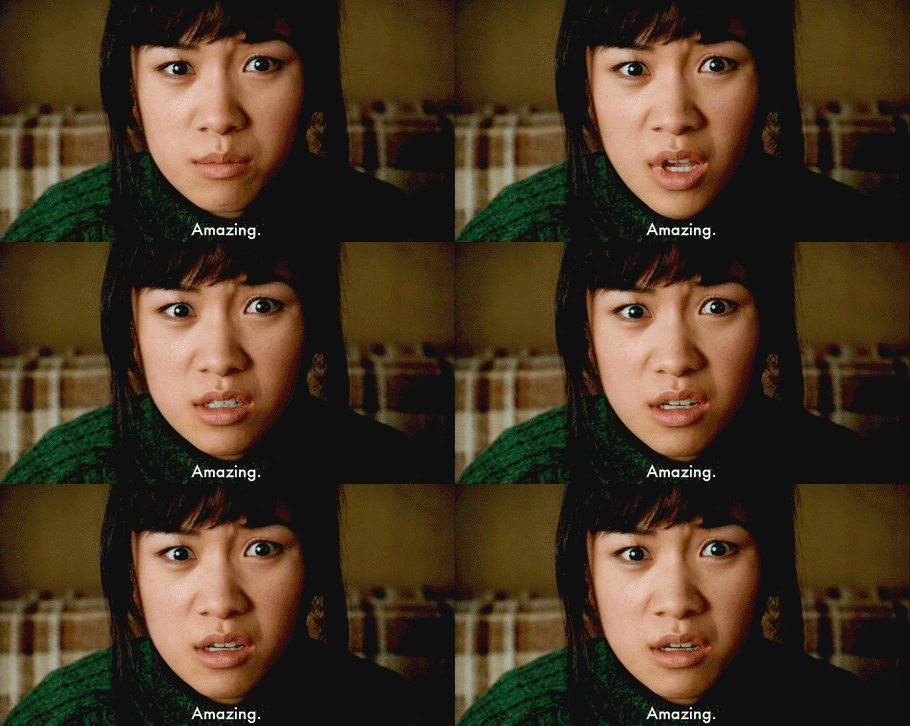
HOLY CRAP, EVERYBODY THAT WAS AMAZING!
We must celebrate in the way of the internet:
With gifs.
 |
| source |
 |
| source |
 |
| You want to dance too. Admit it. Source |
Bask. Bask in the joy of success.
 |
| Source |
So, great job, everyone who contributed.
The reading I've done about overseas adoptees -- on blogs, academic publications, SNS and personal correspondence, has frequently come back to the point that adoptees and birth parents are too often discussed and talked about, but not nearly often enough consulted, or listened to. Which makes it all the more satisfying to see adoptees take control of their own narrative in this case, through good communication and activation of the human networks they've been developing on their own, use their voice, and get heard!
Awesome.
There were a few comments made on this blog and other places that I'd like to address or answer, before we go.
1. "Jeez you PC police are just a bunch of white knights going around looking for things to be offended by!"
Um... actually it was adoptees -- the group represented in the skit -- who were hurt most by this one. No need to manufacture outrage on somebody's behalf. Go read some of the responses linked above. If you're not an adoptee, you don't get to decide what does and doesn't offend adoptees. And even if you are an adoptee, you get to decide what offends you as an adoptee, and not other, or all adoptees. And I checked the response among the adoptee communities and blogs I follow, before writing my piece in support. There wasn't a lively discussion about whether this was offensive or not. There was mostly outrage, disgust, and hurt.
But when, like, almost every single adoptee in your social circle, and almost every adoptee community Facebook page and website has a hurt or offended or angry response to it.... well why don't we listen to them, instead of undermining their right to take offense. Adoptees have been silenced and ignored often enough.
2. Lighten up!
If you told somebody to lighten up or get a sense of humour, you are gas-lighting. Gas lighting is a term popularized in feminist discussion groups, where people kept saying things like "You're getting all emotional" or "Get a sense of humour" to try and make the person doubt themselves - shifting the focus of the conversation from the issue to the person. Go educate yourself on it. Try here and here and here to start. Not all gas-lighting is on the level of domestic abuse (which is where the term originates) -- it's used much more loosely on the internet than in clinics, but the fact is, if you're focusing on someone's lack of a sense of humour: "It was funny to me," then you're side-stepping the actual issues in play here, and also dismissing someone's response, which is just as legitimate as yours in finding it funny.
3. But look: here's a video from America that makes fun of adoptees. Here's a video from America that makes fun of asians.
Umm... those videos aren't cool either. And their existence doesn't cancels out the fact this video is offensive too. Clearly, there are lots of issues to be worked out, in lots of places. And this is one of them. Classic tu quoque.
4. "So we're just going to have a committee to censor everything? You're spoiling the fun."
Ahh the C word.
First: if you are saying this, and you also answer "Of course, naturally!" or even just "yes" to a majority of the 26 statements in this article, it might be time for some soul searching, or some thought about the power of language and media to marginalize groups.
It's not censorship to ask for an apology. It's not censorship to say "this kind of a skit shouldn't have been made in this way." It's censorship to demand SNL Korea be taken off the air. Which didn't happen.
Freedom of speech means that people have the freedom to say something that offends people. But the offended people who say "This offended me" and make a big stink are protected by that same freedom. Nobody should have the right to take freedom of speech away from EITHER of those groups. The word censorship is overused in discussions about what is and isn't in good taste. On the individual level, this isn't a conversation about free speech and censorship. It's a conversation about not being an asshole to people. And if, thanks to a conversation about what an asshole they're being, someone (or a media outlet) decides to change their behaviour, that's not censorship, either. It's just a decision based on new information someone didn't have before, or hadn't thought of, that they've calculated to be in their best interest. And good for them, being so open to new ideas!
That said... there's a difference between an individual saying some stupid offensive shit, and getting the response they deserve... and a major media outlet saying some stupid offensive shit. Because when a major media outlet makes light of the pain an adoptee feels, and there's no response, that normalizes the act of dismissing, marginalizing or putting down adoptees. Even if you're allowed to do something, it may still not be the right thing to do. A kid who saw adoptees get mocked and humiliated without consequences on TV will be more likely to bully my adopted kid (if I have one), and I'm not cool with that. So it's my right and prerogative and maybe my duty to make sure there are consequences if that goes on TV.
Censorship isn't necessarily the answer ... because every time adoptees appear in the media, we get to have a conversation about the issues involved, which helps everyone become better informed and more accepting: that's good! Censoring things prevents that opportunity for conversation. But a clip like this starts the conversation off on the wrong foot, so a backlash like this one is a grassroots way to steer the narrative back along more productive lines. This is a good, healthy process, and the recent incident is an example of redirecting the narrative gone right. Major media outlets do have a responsibility toward their audience, and especially the marginalized among their audience, in the things they publish, and reminding them of that is something that happens in a healthy civil society.
4. So we're not allowed to joke about this topic? That's bullshit! Humour comes from pain! If you're not offending someone, it's probably not funny.
You are allowed to joke about any topic. But there are certain ways to joke about topics, that will cause you to be called and considered an asshole. And you will deserve to be called an asshole. That's not censorship. It's cause and effect. Don't be an asshole. Simple.
And there are ways of joking about any topic that is funny and not hurtful. Adoption included. Sure, humour comes from pain, but comedy is funny because it's audacious, because it's shocking, because it challenges norms and assumptions we take for granted. It's culturally important because it speaks truth to power, taking the bigwigs down a notch by hiding darts under a layer of humour. What's shocking or audacious about kicking someone who's already down? Where's the sport in shooting sitting ducks? That reinforces the norms and entrenches power imbalances, instead of challenging them.
[Trigger warning: the following paragraph briefly discusses rape jokes]
The idea that humour comes from pain was an important part of a recent conversation on a different topic: that of rape jokes. Rape is a different issue, and I have so much respect for survivors of all kinds of sexual assault, and for those fighting for justice in that area. I'm nervous about bringing such a big and important thing into a post on a different topic, because I would never want to give the impression that I'm demeaning, dismissing, or minimizing sexual violence. That said, some of the articles written during that discourse about rape jokes include useful principles for other jokes based on painful experiences as well. If you're interested, read this one. Read and watch 15 rape jokes that work without marginalizing women or rape victims. Read "Anatomy of a successful rape joke." "When Rape Jokes are Never Funny" Basically, the rape jokes that work, do because they attack the structures and people in power: rape culture, or the rapists, or those who bully victims into silence. They point out how hypocritical or vile they are, in such a way that they look ridiculous instead of frightening. This pushes against a norm of silencing or shaming rape victims, who really don't deserve to be kicked around more after what they've been through. A rape joke doesn't have to silence, shame, or blame victims. See the examples in the link above if you don't believe me.
The ones holding the power in international adoption are not the adoptees. The adoptees are the ones who get silenced, or lectured, or infantilized, or put on display. The birth parents get blamed and demonized and disparaged. Silencing, lecturing, infantilizing or putting adoptees on display isn't anything new, so it lacks the surprise that makes good comedy funny. Make fun of the agencies that profit from separating kids from their parents, or the social, economic and cultural institutions that put women at such a disadvantage that they feel they can't support a child. Or the policy-makers who found it easier to smooth the road for adoption agencies than to develop functional social safety net for families in less-than-ideal situations. Mock the media which turns adoptees' search for their families into a tawdry, humiliating, televised spectacle. Or the associations that beatify adoptive parents while demonizing birth parents as unfit or immoral. They deserve all the mockery they get. But not the adoptees or the parents. They have few enough notches already, that it's mean-spirited to take them down another.
"If you're not offending somebody, you're probably not funny"
Horseshit.
Find me someone offended by this. It is perfectly possible to be funny without offending people, and being offensive does not automatically mean you are funny. You can make a comedy show about a vulnerable group, that is actually funny, while also respecting the group. South Park's episode about Tourette's Syndrome checks all those boxes, and was even recognized by the Tourette Syndrome Association: while it focused too much on swearing outbursts (a not-that-common version of Tourette's), they conceded the show was "surprisingly well-researched" with "a surprising amount of accurate information conveyed" and parts of its plot serving as "a clever device for providing ... facts [about Tourette's] to the public." It can be done... people who do it (Louis CK or Sarah Silverman for example) amaze me, because tackling a sensitive topic while being respectful and also funny is a praiseworthy display of virtuousity. Any clumsy jackass can go for the cheap shot. So let's just throw that offensive/funny canard out the window.
5. But this skit was trying to satirize Korean adoptee shows, which create situations like this reunion. And it's a step forward that a comedy show is talking about adoption, rather than continuing the conspiracy of ashamed silence.
This is based on a facebook comment by the Metropolitician, Michael Hurt, a long-time resident, with kickass knowledge of the culture and language. It was far and away the most thoughtful critique of the SNL backlash. He argues that this skit mocks other adoptee reunion shows -- even the name of the program at the beginning (here's the actual program of the same name) -- references them. He argues that this mockery of a reunion scene will make it harder for the actual TV shows that trade on adoptee reunions, to continue putting adoptees on display and making their most personal moments into a schmaltzy scene, kind of the way Austin Powers mocked the conventions of the James Bond franchise so accurately that the franchise had to completely reinvent itself with a reboot to avoid self-parody and irrelevance, I think.
He finishes his long facebook comment with this:
Food for thought -- I think that staging the skit as a replay of an actual television show first meeting, which they often were, would be a bit too direct for the defamation-suit-minded media outlets here, especially given the fact that the title of the skit references a show South Koreans all know, and that staging it as a true first meeting in the airport, without the cameras and onlookers allowed for a chance to let the audience "off the hook" dramatically, since the parody of the melodramatic meeting slips into actual melodrama at the end, where you can hear real "awws" and such from the stdio audience. Works well and is perfectly crafted to the Korean audience that is indeed sick of this beaten-to-death trope as well, but still would like the comedy to feel "kind" and not mean, as is the wont (and want) of Korean audiences, methinks.Personally, I think if that was the purpose of the skit, it fails to deliver, but I respect the argument and the way it was made, and the knowledge of the context out of which it comes. I don't think it's clear enough to viewers that those programs, and not adoptees themselves, were the target of the laughter, especially Jason Anderson speaks Korean in such a way that it sure comes across as "lol badly spoken Korean is SO funny!" If that was their goal, they probably should have thought about how the skit would "read" to adoptees who weren't fluent in the cultural idioms they were referencing, or added enough clues for them to be in on the joke. It wouldn't be the first time comedy has failed to cross cultural lines... but it becomes more confusing and fraught because adoptees were part of Korea's culture and society... until they got sent overseas. Ultimately, though, I'm not convinced that the skit has done enough work to deflect the mockery away from Jason Dooyoung Anderson, and onto the proper targets. Which might be a question of taste... but I think if that was the intention of the skit, it was poorly executed. Which is better than being purely ignorant or spiteful, but still troublesome.
That's the end of the commentary I want to make, so with one more mention that... holy cow it's awesome that adoptees took control of their own narrative with this incident, and all credit and praise go to them! I'm wrapping up this post.
Have a great one, friends.


