Tuesday, March 30, 2010

YAARGH! YES, stupid: in Korea, marijuana IS a big deal. Stop being Dumbasses, English Teachers.

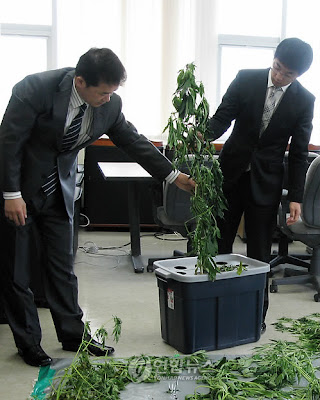
Hey there, everybody. Popular Gusts reports on another arrest of foreign-born Korean English teachers, for growing marijuana. Now, yeah, I'm glad they were Korean-American instead of straight-up WASPs, because it means English teachers catch a little less heat... but every time English teacher, Marijuana, and Arrest are in the news, no matter if the English teacher was White, Korean, Filipino, Chinese or Martian, a little guilt by association goes around.
So I just want to fire off a short rant:

OK. I know that because of the high turnover rate of English teachers, maybe it has to be repeated, over and over.

According to the article, "Said grower also said that in America smoking pot isn't considered to be a big problem." And this is something I've heard before, in other places, as if this is why they expect the police to follow Alaskan marijuana law instead of Korean law, when dealing with a foreigner arrested for possession in Korea.

OK, dear readers, here's the thing. First of all, we foreigners have all had the discussion where we've said that in general, Koreans don't have much concept of there being a spectrum of drug severity -- that is, marijuana is not that dangerous a drug, while things like heroin or meth are the real life-wreckers that Korea should be fighting against, and lending headline space. I'm from the Vancouver area, so I might have had "the marijuana talk" more often than others, thanks to discussing it with the hometown pals, even though I've never been a user myself. Going to a Christian university meant that it was available if I went looking for it, but I couldn't really be bothered to.

We can all agree that there isn't a lot of nuance in the idea that all illegal drugs are equal, in the same way that there isn't a lot of nuance in the idea that all mental illnesses are tantamount to being f*#^ing crazy - that all-or-nothing thing has been extensively discussed in different places.

And my dear readers, I'm sure all of you are fine, upstanding citizens who'd never think about using drugs while you're teaching English, or living in Korea... But maybe, some people will drift across this post while googling for information about drug use in Korea, so it's time for me to say it.

It doesn't matter if we think Korean thinking about different kinds of drugs is un-nuanced... because we're not the ones who write Korean law! It's not our job to introduce the Koreans we meet to the argument that alcohol is a more dangerous drug than marijuana... even though some say it is. And frankly, given the amount of stigma against drug use, and the way that illegal drugs have been presented to Koreans by the Korean media, we're butting our heads against a wall if we take it upon ourselves to enlighten every Korean we meet with that little pearl.

Rather than open Koreans' minds to a whole new world of grey areas and "soft drugs," what having that conversation most often does, is serve to reinforce the stereotype of "Morally unqualified, drug-addled English teacher, who in his/her arrogance, thinks they should change Korea to be exactly like their own country" that we've been trying to live down for half a decade or more.
(from here)

So here's what papa Roboseyo suggests, as per "the drugs discussion" in Korea. I would be happy if these ideas circulated widely, and that every first year English teacher, during their first month, were emphatically advised by a colleague that:

1. At this point, between the risks and penalties and the way Koreans think about drug use, combined with the way drug use is so often associated with English teachers, it just isn't worth it to use drugs while you're in Korea. Don't do it, don't look for it, just stay out of that mess. I've actually met people who came to Korea to successfully clean up, and get off the ganj, and they succeeded. Korea's good for that. Korea's NOT a good place to get high, unless your drug of choice is either alcohol, or really spicy food. Pot IS a big problem here, and if you resent that pot's legally or practically decriminalized in parts of North America and in the Netherlands, but it's still very illegal here, then go back to Portland, Denver, Amsterdam, or Vancouver Island.

2. Rather than try to add ambiguity and nuance to the discussion, when Koreans who don't know you very well, and whom you don't know very well, bring up the topic of drug use, stick with "I respect Korean laws, so I don't do drugs while I'm in Korea." If they pursue it, "Whatever I did back home, in a different culture, doesn't matter much to my life in Korea, because while I'm in Korea, I respect the local laws." If they still pursue it, gently change the topic.

3. Add "nuanced discussion of the relative severity of different illegal drugs" and "alcohol is the drug that should really be illegal, and Korean workaholics would benefit more from smoking marijuana after working their 12 hour shifts, than they do from getting shit-faced" to the list of topics to be brought up delicately and probably infrequently, and only with Korean friends who know you quite well, and whom you know well enough to read whether they're growing uncomfortable with the conversation, along with "complaining about Korea" "ugly nationalism" "views deviating from the Korean norm regarding Dokdo, the Japanese colonial era, war crimes, apologies, and comfort women," "Korea's sex industry" "corruption" "Korea's not actually sexually conservative" "racism in Korea" and "open discussion about sex."

Can we all agree to follow those principles, and ask our new co-teachers to get on board? Pretty please?

Monday, March 29, 2010

Wanna Chat with Foreign Beauties? How to Make Friends with a Foreigner Part 4

This is part 4 of a series on forming friendships between Koreans and expats. It sure isn't the final word on the subject, but maybe it's a start.

In some kind of search for balance, because I can only represent the expat's side of the equation, I asked a few of my "Korean Korean" readers to contribute some advice and insights from the other side. Those posts will alternate with these ones, in an effort to redress the imbalance.

Tip 11: Be careful. Don't ask any question where the answer might upset you, and don't expect me to answer questions the same way most Koreans would.

For example, let's take the question "How do you like Korean women?" - a somewhat common question. When somebody asks this, it seems like a trap to me, because there's only one answer I can give: praise. It’s like the stereotyped girlfriend who says, "Do I look fat in this dress?" - she doesn't want an honest answer. She wants a compliment. Fishing for compliments is insincere and a sign of insecurity. Why is it my job to make you feel better about your country's women?

Next problem: what if I give an answer you didn't expect, or won't like? What if I had some bad experiences with Korean women, so I say something really nasty? Are you ready to accept that answer, and talk about it, without getting defensive? If not, don't ask the question. This is why I usually refuse to answer the question "What do you dislike the most about Korea" -- because too often, the person who asked the question got upset when I answered honestly. Clearly, they didn’t think about whether they really wanted to know my answer to their question. This kind of awkward situation will kill any chance of a developing friendship.

Tip 11.1: Don't be surprised if I give a different kind of answer than you'd expect, either. I probably won't repeat the talking points covered in the Korean media, because I don't read Korean newspapers or watch Korean news, and I don't always share the opinions that are common among Koreans. Basically: be aware of what you're getting into if you ask about controversial or hot topics, particularly ones that involve nationalism, China, America, Japan, and especially Dokdo.

Tip 12: Be considerate. Don't introduce me to the stranger parts of Korean culture unless I ask you to, or please prepare me for what's coming. A student once told me about taking his new foreign coworker out for Korean food, and suggesting he try Fermented Skate (홍어/Hongeo), without telling him what it was.

It’s not really surprising that the new coworker lost all interest in trying Korean food, and ate sandwiches and western foods for the rest of his time in Korea. By introducing his partner to the weirdest parts of Korean cuisine first, and treating parts of Korean culture as a practical joke to humiliate a colleague, he caused the coworker to completely close his mind to other Korean foods that he might have liked.

Introducing the weirdest parts of Korea first will usually have three effects on a foreigner experiencing culture shock: 1. it'll make her lose interest in learning more, and 2. it'll make her feel like an outsider who could never fit in, and 3. it'll make her resent you for using her to show off that you ARE an insider, while she isn't. It’s disrespectful to a person to make them feel like an outsider (this is why it’s also impolite to talk about me in Korean while I’m sitting at the table with you, especially if everyone present can speak English.) It’s also a terrible recipe for a friendship.

Some foreigners DO want to try boshintang, bundaegi, sea squirt, and hongeo, some DO want to go to a full-length pansori performance, or see the bullfighting in Cheongdo, and look around the dog market in Moran. If I want to do those things, and you've agreed to introduce me to Korean culture, I'll ask. However, many of us would rather experience the side that's easier to handle, and if you introduce the weird stuff to me without context, without preparing me, or explaining that most Koreans don't like hongeo, either, that dog meat is less popular than it used to be, or if you play the "do you know what you just ate?" game, I'll start thinking of Korea as a weird, backwards place full of strange people who eat and do strange things, and who certainly enjoy rubbing my face in the fact I’m not one of them. Is that the impression you actually want me to have? Moreover, is creating that impression worth the cheap laugh you got when I bit down on that sea squirt and made that funny face? (That actually happened to me, and it was very embarrassing.) Korean culture is not a prank to be played on outsiders, and treating it that way is a disservice to foreigners, and to your own culture.

Thursday, March 25, 2010

Wanna Chat with Foreign Beauties? How to Make Friends with a Foreigner Part 3: Questions and Comments

This is part 3 of a series on forming friendships between Koreans and expats. It sure isn't the final word on the subject, but maybe it's a start.

In some kind of search for balance, because I can only represent the expat's side of the equation, I asked a few of my "Korean Korean" readers to contribute some advice and insights from the other side. Those posts will alternate with these ones, in an effort to redress the imbalance. Here we go...

Tip 10: Be different. Almost every time a Korean approaches me to start a conversation, they start off with the same questions:

Where are you from? How long have you been in Korea? Can you speak Korean? Are you married? Why did you come to Korea? Do you like Korean food? What's your job? ... and so on. Honestly, it gets boring answering the same questions every time... which means that if you ask all the same questions as everybody else asks me in the first five minutes after you meet me, my first impression will be that you're terribly boring: a bad start for a friendship.

Repetitiveness is bad. And sometimes frightening. (gif from here)

Most of the common questions are perfectly good ones, so feel free to ask them later in the conversation, but not all at once right after you meet me, OK? If you ask more interesting, and more varied questions, I'll be more interested in talking to you again.

Tip 10.1 Here are some questions that are too personal for the first five minutes after you meet someone. Save them for later, if you ask them at all.

How old are you? How tall are you? Is your hair naturally blonde/curly/red? (How would you feel if I asked, “Are your eyelids are real or surgical?”) "Tell me about your family" is always better than "Are you married?"

Tip 10.2 These comments are strange or uncomfortable in my culture:

Any comment about someone's personal appearance, even positive things, too early in a conversation. "You are very handsome" or "You are very beautiful" is a strange thing to say to a person right after you meet them: it sounds like a pretty strong come-on. It is especially uncommon for men to compliment another man's looks in North America.

"You have a small face" and "Your skin is so pale!" -- these are not considered compliments to me. Nobody pays attention to big or small faces where I’m from, and "You have pale skin," to many white people, is like saying, "You're looking a bit sick."

"Your skin is pale" makes most white folks think of something like this: (source)
not something like this:


"You have nice eyes" is better than "you have big eyes".

"You look like (famous western person)." This one reminds us of that stereotyped and racist saying "they all look the same to me" -- especially when every curly-haired man looks like Tom Hanks, every blonde woman looks like Nicole Kidman, and every bald man looks like Bruce Willis. Don't say this one unless I really, really, really do look like the person. Imagine traveling in Europe and having people tell you that you look like Jackie Chan or Lucy Liu. Again and again and again.

Tip 10.3 Just Annoying:

"Are you from America?" (non-Americans HATE when people assume they're American. Imagine if everybody said "Konichiwa" to you during your tour of Europe.) "Where are you from?" is better.

"What do you think about Korean women/men?" (basically means: "I want you to flatter the people of my country.")

"Can you eat spicy food?" (unless we're about to order a meal together, this one is strange, especially because the stereotype that foreigners can't eat spicy food isn't always true.)

Not. Always. True.

Tip 10.5 Very rude in our culture:
Any comment about somebody's weight, any negative comment about someone's looks.

I've heard so many expats in Korea complain about well-meaning people saying things like "Are you sick? You look really terrible!" Once I was giving level tests at my adult language school, and the first words the student said when he sat down for the interview were "you look terrible!" He wanted to show concern, or interest in me. Instead, he offended me, and made me immediately dislike him. Just sincerely ask "How are you doing" or "You don't seem well...is everything ok?"

One last thing: if you ask "Is your girlfriend Korean?" and your tone sounds like you don't care if she is or not, I don't mind answering, but if you make the question into a big deal, I wonder why you care about it: you're talking to ME, not her, and if interracial dating is a big deal to you, I start thinking you might be a little bit racist.


OK! I hope that was fun for you. Have a great day, and stay tuned for part 4!

Back to the table of contents.

Wanna Chat with Foreign Beauties? How to Make Friends with a Foreigner: Equivocations

OK. I realize that the portrait that is slowly forming, by listing all the different ways these discussions go wrong, doesn't look good. Yes, these bits and pieces of awkward situations somehow collect together, and form a false image of some kind of "FrankenKorean" - a mix of all the worst parts of every Korean every expat has ever met. I've written before about how that kind of stereotyping and judgement is harmful, and it goes both ways, and it gets ugly.

So before the Keyboard warriors get going, hear me out. I want to be clear that these tips, held all together, creates a composite image of a Korean who does not exist. I know that. You know that. And now you know that I know that. These social blunders are not a description of my entire experience with Koreans, and nobody's socially clumsy enough to make every one of these mistakes in a single conversation. I've met many Koreans who are very socially adept (many more so than I am), and some, many, with manners that put me to shame.

However, in the course of meeting several hundred, maybe even a few thousand Koreans in the last seven years, I've seen a great variety of people, and while most of them are very socially adept, not all of them are. And while most of them don't commit these blunders, some have. In fact, enough have, and continue to do so, that these items were worth mentioning.

And the best thing is: most of these errors are easy to correct: a little awareness, and a little consideration of foreigners as fully functioning, feeling human beings, will take care of most of it. So before anybody gets in a snit, bear in mind what I'm trying to do here, and why I'm trying to do it, and as I said right at the beginning: if this stuff doesn't apply to you, ignore it!

Conversely, the same thing applies to we foreigners: so far, most of the advice I've heard directed towards foreigners boils down to being considerate. . . but why deliver a message in those two words, when I could deliver them in several thousand, eh? So, on with the series...

Back to the table of contents.

Wednesday, March 24, 2010

Link Dump

Some articles that caught my eye last time I combed through all my favorite news sites:

Coincidentally, it's a little "Chosun Ilbo" heavy, but that wasn't intentional.

The most important link of the day: Read about North Korea's Worst Concentration Camp -
The Jeungsan Reeducation Center in South Pyongan Province has a reputation for cruelty and the saying goes that even healthy people leave as cripples.
This camp is especially for women's reeducation, and everyone in the world should be reminded, between Paris Hilton videos and Kim Kardashian scandal rumors, that this is happening, too.


While this doesn't mean Foreigners and Koreans can never understand each other or be friends, articles like this are good starting points for trying to find a middle-ground of understanding, when foreigners and Koreans try to make friends. On the other hand, you have to question a survey that surveys "foreigners" rather than, say, groups from distinct countries.

"Improving Korea's Status takes More than Cosmetic Measures" - an editorial saying something similar to my rant about branding.

Korean Women Reject 'Drink or Be Fired' Culture - looking at the way women fit into Korea's alcohol-soaked "if the boss says, you MUST drink" business culture. (ht Brian's twitter)

26 Reasons What you Think is Right is Wrong - a bit of critical thinking (ht James Turnbull's twitter)

"For Koreans, the Spicier the Food the Better" - Koreans like spicy food. Nothing special there... but the picture, with its "Blonde hair bignoses can't eat spicy food" stereotype-reinforcer, is a bit... condescending?

Maybe the blonde haired bignose is now simply cartoonist shorthand for "Non-Koreans" but being a blonde haired bignose myself, well, I still resent it.